

In Sydney, Australia, Shu Yeung is turning Sunday mornings into engaging lessons on taste, craft, and connection.
BY VASILEIA FANARIOTI
SENIOR ONLINE CORRESPONDENT
Photos courtesy of Sydney Coffee Tour
It’s 10 a.m. in inner-city Sydney, and a group of strangers huddle around a barista pulling shots at a small café. Their guide, armed with a bright smile and a head full of stories, explains the difference between batch brew and espresso—not with jargon, but with patience and humor.
“It’s not okay to assume everyone knows what a batch brew is,” he says. “Processing methods? Forget it. The name of the farm and producer? Doesn’t stick. That’s sad. All these things are what specialty coffee is all about.”
For the past few years, Sydney Coffee Tour has been quietly transforming Sunday mornings into hands-on lessons in coffee literacy. Part walking tour, part sensory workshop, part cultural exchange, it’s the creation of Shu Yeung, a man who never set out to be an educator, but couldn’t help becoming one.
From Tokyo to Sydney
The idea of the tour, Shu says, came from two sources: exploring specialty cafés in Tokyo and his “unbound enthusiasm for sharing coffee recommendations with complete strangers” at Diggy Doos, a café in Sydney’s Inner West. “You’ll never find a shortage of people interested in café recommendations,” he laughs. “I often found myself stopping short of physically taking them to the spots.”
A pivotal moment for Shu came during a pre-pandemic trip to Japan. “I was in Tokyo just before COVID swept the world,” he told Barista Magazine. “I made a map of over twenty cafés stretching from Ibaraki to Shinagawa and tried to visit all of them. I walked a lot with a cupping spoon in my pocket and a camera. I saw a lot of Tokyo but didn’t see many landmarks. It was a good way to explore.”

When Shu returned home, he did the same thing: mapping, walking, tasting, documenting. Sydney became his new Tokyo. Diggy Doos became the hub where he would share stories and recommendations: the seedbed for an idea that felt, as he puts it, “pretty obvious in hindsight.”
The Gap Between Industry and Audience
Education wasn’t part of the original plan, but after months of running tours, Shu noticed a disconnect between how specialty coffee professionals talk about their craft and what everyday drinkers actually understand.
“There’s a gap between what the industry regards as ‘basic’ and what your average coffee drinker regards as ‘basic,’” he says. “Things that roasters put time and money into—origin cards, special releases, packaging—are too advanced for most people. I used to be that person for a long time.”
This realization shifted the tour’s purpose. It wasn’t just about showing people new cafés; it was about giving them the language and context to engage with specialty coffee meaningfully. “Education became the centerpiece,” Shu adds. “It was the most responsible thing to do when people chose to spend their Sunday mornings on my tours.”
Designing the Experience
Each of Shu’s coffee tours is unique, with a new route, a new theme, and a rotating cast of cafés chosen with care. “The cafés need to be specialty. They should have a considered approach to the coffee they’re offering,” he says.
Accessibility matters, too. “Ideally, they’re walkable or easy by public transport, and the suburb should be different every week,” Shu explains.
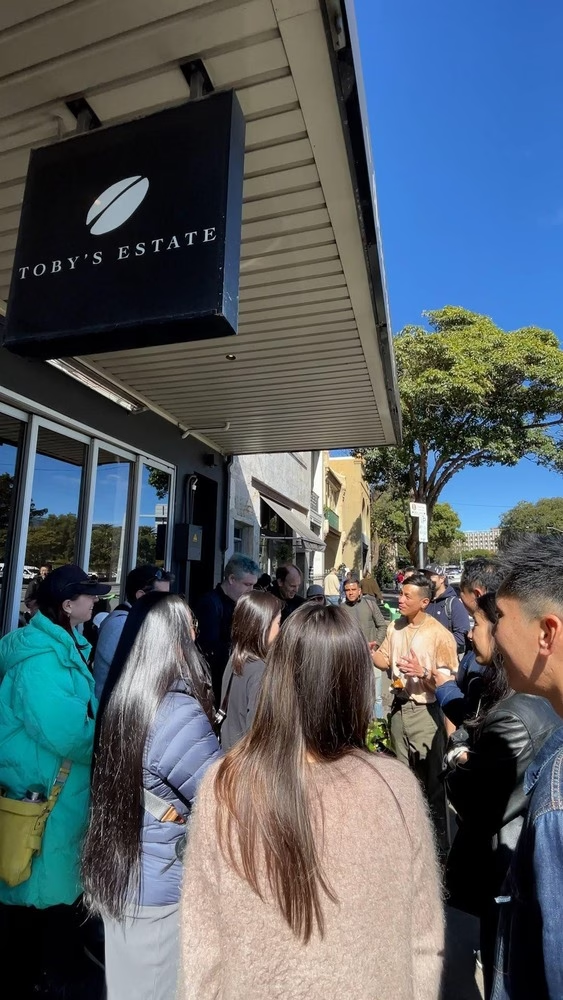
Shu describes the tours as modular: Each one stands alone but also builds on the previous. “Coffee is a multi-faceted story, so for me it needs to be told this way,” he says. “I want people to leave better equipped to engage with what roasters are producing—to look at an origin card or a tasting note and actually feel something.”
The format allows for creativity. No two Sundays are the same. “It sounds like a lot of work—and it is—but since I have no choice but to attend every tour, it needs to be interesting for me,” he jokes.
Stories that Stick
Storytelling, Shu believes, is the most powerful teaching tool. “I try to learn and commit to memory as much as I can about each café we visit,” he says. “It’s important for people to hear the stories behind the cafés: how they came about, why they came about, what experiences I’ve had there. It gives people a new lens to re-examine their world.”
Sometimes, those stories stretch back centuries. “Knowing Seven Seeds is a café is different when you’ve been told about the seven seeds Baba Budan smuggled out of the Port of Mocha in his beard,” he says. “If I share a story, there’s a purpose to it: to connect the listener to some aspect of coffee so they become an informed consumer. You are what you drink.”
Shu shares that he avoids trivia for trivia’s sake. Every anecdote is in service of connection—between producer and drinker, between idea and cup.
A Practice of Everything
Community is at the heart of Shu’s philosophy. “Coffee is a platform,” he says simply. “It’s a way I can connect with different people and share information and ideas.”
He also shares that he sees coffee as deeply tied to identity. “Food and identity are inextricable. When you drink specialty and I drink specialty, we share an identity,” he says. “On my tours, it’s like being welcomed into someone’s home while you’re abroad. When you take a sip, you’re bound to the space and the people by your stomach. You speak with the same flavors on your tongue.”

Then, with characteristic humility, he adds: “But coffee is just one of many things for me. Have you heard the phrase ‘everything is everything’? That’s what coffee is: a practice of everything.”
Lessons from the Street
One of Shu’s favorite memories came from Tour 9: an ambitious event introducing people to drip bags and steep bags through a street-level coffee competition.
“About 25 people turned up, and the chemistry was perfect,” Shu recalls. “I split the group into teams and made the most inexperienced person the brewer. We repurposed some street barricades near Reuben Hills as brew bars. I remember stepping back to get some footage and seeing everyone together—different countries, different cultures, all making coffee on the street—and thinking, this is what it’s all about.”

Moments like that reaffirm Shu’s belief that education doesn’t have to be confined to classrooms or competitions. Sometimes, it’s just people brewing together on the sidewalk.
Balancing Passion and the Grind
When asked how he keeps his enthusiasm alive, Shu laughs: “You mean how do I stop the grind from killing any interest I have in coffee?”
He answers his own question: “I made a promise to myself to stop when I’m no longer having fun.” But when that happens, his problem-solving mind kicks in. “Whenever I’m not having fun, I try to figure out how to have fun again. The solution I keep returning to is: Do what you like,” he says.

It sounds simple, but Shu treats it as a discipline. “When I plan a tour or make content, I have to be excited or curious about it. From there, I craft it so it serves people—but it has to be something I like first. That’s why I hand-draw posts or spend weeks editing an article only a handful of people might read. The answer is: because I do what I like.”
The Challenge of Money and Meaning
Behind Shu’s humor lies honesty. Money has been the hardest part. “The funding model was something I struggled with for years,” he admits. “I couldn’t think of a price that would be fair to both myself and the people attending.”
He shares his decision to make the tours free, with the option to contribute: “I don’t ask cafés for discounts—it doesn’t feel right. I’d rather accept an unexpected offer; it’s more genuine.”
The gamble worked out: “Every tour has broken even. My supporters have covered the coffee costs, the website, the tools. What’s left over buys a few coffees to review,” he says.
Still, the emotional toll was real. “It was mentally draining. I tried not to link the effort I put in to the amount people contributed—but the more you fight it, the stronger it gets.” he says, then pauses. “The lesson is how to be happy doing something regardless of the balance sheet.”
A Caffeinated Future
Looking ahead, Shu is brimming with ideas: a charity event (the details of which he can’t fully reveal yet), a coffee cart concept, and even an origin tour someday. “It’s theoretically possible,” he says, “but still feels far off.”

As for the bigger picture, he sees Sydney’s specialty culture growing healthier and more diverse by the year. “There are coffee parties, trivia nights, regular cuppings. It’s a sign of a healthy, caffeinated pulse,” he says. “Outside the community, though, most people still don’t know what specialty coffee is. That’s the gap I’m trying to close.”
He smiles, finishing his cup. “Coffees are diverse, cafés are diverse, people are diverse,” he says. “So being new is a welcomed thing.”
ABOUT THE AUTHOR
Vasileia Fanarioti (she/her) is a senior online correspondent for Barista Magazine and a freelance copywriter and editor with a primary focus on the coffee niche. She has also been a volunteer copywriter for the I’M NOT A BARISTA NPO, providing content to help educate people about baristas and their work.

Subscribe and More!
As always, you can read Barista Magazine in paper by subscribing or ordering an issue.
Support Barista Magazine with a Membership.
Signup for our weekly newsletter.
Read the December 2025 + January 2026 Issue for free with our digital edition.