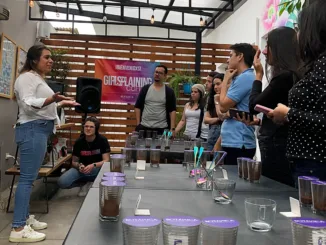

Krzysztof Blinkiewicz, founder of Red Ink Coffee, shares why coffee education shouldn’t simply teach brewing or roasting skills, but how coffee interacts with climate, culture, and community.
BY VASILEIA FANARIOTI
SENIOR ONLINE CORRESPONDENT
Photos courtesy of Jørgen Krokan Ledal unless otherwise noted
Coffee education has expanded rapidly over the past decade, with a growing range of courses, certifications, and training pathways available to industry professionals. Within this landscape, Red Ink Coffee offers an approach that places particular emphasis on context, systems thinking, and the relationship between coffee knowledge and the wider world.
Founded by Krzysztof Blinkiewicz—journalist, Q Arabica Grader and former AST—Red Ink Coffee positions education not only as skill development, but as a space for reflection, responsibility, and long-term thinking about the coffee industry. In this conversation with Barista Magazine, Krzysztof shares how this philosophy shapes both the structure and intent of Red Ink Coffee’s educational work.

A Philosophy Before a Curriculum
At the heart of Red Ink Coffee’s educational model is a philosophy that coffee education should not simply teach better brewing or roasting skills—it should question why and how education serves the community, the planet, and the people who make coffee possible. The organization operates as the educational arm of The Better Coffee, a framework seeking to “re-imagine how coffee is traded, taught, and valued.”
“Too many coffee courses teach technique without context,” Krzysztof says. “Our goal is to create a space where students not only learn about coffee science and sensory skills, but also understand the environmental, social, and economic systems that coffee lives within.”
This mission is deeply rooted in Red Ink Coffee’s broader vision—a radical restructuring of how coffee knowledge flows through the supply chain in ways that emphasize dignity, equality, and mutual aid.

The Better Coffee Curriculum: Structure With Purpose
Unlike conventional tiered certification programs that push learners up predefined ladders of skills, Red Ink Coffee’s The Better Coffee Curriculum is non-linear. Each course is a node in a network of understanding rather than a rung on a ladder of status.
“The curriculum isn’t about chasing certificates,” says Krzysztof. “It’s about building frameworks that help learners think critically about coffee—not just how to cup or roast, but how coffee interacts with climate, culture, and community.”
The curriculum encompasses a range of offerings that reflect this expansive approach:
- The Better Coffee System Course — designed to help participants apply a values-based methodology across the coffee value chain, from farms to cafes. Students are introduced to principles of quality assessment that transcend flavor alone and incorporate social and ecological considerations.
- Sensory Performance and Coffee Profiling — far beyond basic sensory cupping, these courses push learners to refine perception and to communicate sensory experience with precision and meaning. The Coffee Profiling course, for example, integrates practical roasting with sensory analysis and marketing insight.
- Fermentation and Ecology Courses — bridging science and practice, these sessions delve into fermentation’s role in coffee complexity while emphasizing local environmental stewardship.
- Ecology and Sociology of Coffee — a course that acknowledges climate change and demographic shifts as integral to understanding the future of coffee.
What’s clear is that Red Ink Coffee doesn’t treat coffee education as a siloed technical endeavor; it sees it as fundamentally interdisciplinary.
Learning Within Real-World Conditions
Another defining feature of Red Ink Coffee’s educational model is its willingness to engage directly with difficult topics. Courses on the ecology and sociology of coffee address climate change, labor realities, and generational shifts within producing and consuming communities.
“Avoiding uncomfortable conversations doesn’t make the industry healthier,” says Krzysztof. “Education should give people the tools to sit with complexity instead of simplifying it away.”
Rather than presenting solutions as fixed answers, Red Ink Coffee frames learning as an ongoing process. Participants are encouraged to question assumptions, share experiences, and consider how their own positions influence how they understand coffee.

Community as a Learning Space
While Red Ink Coffee offers structured courses, it also invests heavily in creating spaces for dialogue. Openly shared resources such as The Better Coffee Blueprint extend learning beyond the classroom, inviting collaboration among baristas, roasters, producers, and educators.
“Some of the most meaningful learning happens between people, not just during lectures,” Krzysztof says. “We try to design education that leaves room for exchange—for disagreement, curiosity, and growth.”
This emphasis on shared inquiry reflects Red Ink Coffee’s belief that knowledge in coffee is collective, shaped by lived experience as much as formal study.

An Invitation to Think Differently
Rather than presenting itself as a definitive model for coffee education, Red Ink Coffee offers its work as an invitation—to slow down, to look more closely at how coffee systems function, and to consider education as a form of care for the industry’s future.
“We’re not trying to tell people what kind of coffee professional they should be,” Krzysztof says. “We’re creating tools that help them ask better questions about the work they already do.”
In a time when the coffee industry faces increasing environmental, economic, and social pressure, Red Ink Coffee’s educational approach suggests that learning can be both rigorous and reflective: grounded in skill, but attentive to the wider world coffee inhabits.
ABOUT THE AUTHOR
Vasileia Fanarioti (she/her) is a senior online correspondent for Barista Magazine and a freelance copywriter and editor with a primary focus on the coffee niche. She has also been a volunteer copywriter for the I’M NOT A BARISTA NPO, providing content to help educate people about baristas and their work.

Subscribe and More!
As always, you can read Barista Magazine in paper by subscribing or ordering an issue.
Support Barista Magazine with a Membership.
Signup for our weekly newsletter.
Read the December 2025 + January 2026 Issue for free with our digital edition.
For free access to more than five years’ worth of issues, visit our digital edition archives here.