
Coffee against the backdrop of nature—this is the latest project of world-famous restaurant Noma.
BY BENJAMIN SAND
FOR BARISTA MAGAZINE
Photos by Benjamin Sand
As the grasslands adopt the cloak of late autumn, shedding verdant hues for russet, the Noma Projects greenhouse in Copenhagen, Denmark, reflects these changes. Perched on a sliver of land, flanked on both sides by water, a new coffee experience has launched within the glass chamber. Visible through the windows, water vapor billows from the chimney of Amager Bakke, a waste-to-energy plant, as a reminder that sustainability takes many forms. You can almost taste the duality.

Trying New Things
Noma, led by René Redzepi, is a three-Michelin-star fine-dining restaurant in Copenhagen. It’s an enigma that defies categorization and strives to reinvent and renew itself every few months. As a strong proponent of sustainability, the kitchen practices foraging and uses local produce, and has a large team that constantly experiments with techniques and trials to create exciting flavors.
Anchored in an old naval warehouse, several greenhouses attached, serving different purposes. The first you’ll reach from the road is home to the Noma Projects shop, a mad-scientist laboratory displaying the results of experiments with fermentation, drying, preserving, and dehydrating—all methods used by the Noma team to alter or coax out new dimensions of flavor. Visitors who crave parables on petrified ponzu, yarns about yuzu, or sermons on sorrel: This is where you enter the rabbit hole.
Sharing the same space, behind a hanging photo wall, sits Noma Coffee. This new permanent feature at Noma Projects’ greenhouse opened in October. With the space bathed in natural light, the Scandinavian philosophy of minimalism is adhered to, without sacrificing a welcoming atmosphere. With marble-wash cupboards, Modbar espresso cranks, bags of coffee, and pourover gear speckling the countertops, the space has that tonality of clean yet comforting.
“We wanted it to feel open and unpretentious, like you’re just stepping into our world for a cup of coffee, not into a restaurant’s reputation,” says Carolyne Lane, Noma’s head of coffee.
Full-length windows frame the garden, and through a sliding door, a small backyard welcomes the cold-blooded in times of frost, aided by a fire bowl. Come summer, the backyard will likely see peak occupancy, immersed in sunlight and effervescence.
Inside, the greenhouse is narrow, and metal stools and repurposed tree trunks serve as furniture. Menus read straightforwardly: Espresso drinks, milk-based or black, three options for pourover coffee—at the time of this writing, the choices were an Ethiopian Chelchele, along with a Caturra and a Gesha, both from Huila, Colombia. Filter coffee is prepared on Hario V60 drippers, with filter papers courtesy of Sibarist. This ensures a fast flow rate, which can perfectly balance the bright, clean notes with a more tea-like body.
There is no pastry menu; however, being Noma, the shop has had various pop-ups to sell “chocolate” made from koji, raspberry pastries, and chocolate sourced from Mexico, studded with nuts. The theme is not about replicating the countless pastry shops Copenhagen is famous for; it’s about the coffee.

Noma’s Coffee Journey
Noma first transformed their coffee game with the guidance of Norwegian seer Tim Wendelboe. One of the world’s most respected coffee roasters, Tim joined forces with Noma in 2012, a relationship that would continue for many years. He consulted with the team to fine-tune post-meal coffee service to multiple tables without compromising on quality. The challenge: not to overwhelm the palate after an intense multicourse tasting menu. The goal was a cup that had flavor and body, but not as bold as an espresso.
After some experimentation, they came up with the Nomacano, a middle ground between espresso and filter coffee. By brewing a concentrate of light-roast coffee in an espresso machine, then adding a ratio of hot water as service was called, diners could enjoy a fresh, complex, tasty cup of coffee together. This also enabled all Noma staff to follow the recipe and consistently produce a delicious result.
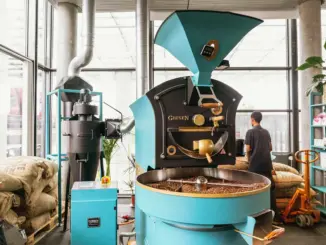
The next major step was the launch of a subscription service in 2024, marking the first time the outside world heard about Noma coffee. Head of coffee, Carolyne, personally sources all the green coffee, which is roasted nearby at The Coffee Roasting Company, under the watchful gaze of head roaster Alastair Hesp. The subscription service opened the doors for enthusiasts to brew Noma coffee anywhere in the world, but it still limited non-subscribers, as well as tourists and locals, from accessing it.
This all changed in October 2025. But let’s rewind a bit.
Meet Carolyne Lane
Carolyne’s path took a few turns before ending up at Noma. While working at a wine bar in Bielefeld, Germany, she was first introduced to specialty coffee by the owner, who embraced sustainability and the importance of working closely with producers. From that moment on, the seeds for coffee fascination were planted and grew over the next five years. “Working in a natural wine bar taught me about sustainability and traceability, ideas that later shaped how I think about coffee,” she says.
Drawn by Noma’s heavy focus on natural wines, combined with their existing coffee program, Carolyne decided to throw caution to the wind and drove up to Copenhagen and knocked on the doors at Noma. They opened. Bridging the gap between the seeds sown in Bielefeld and an ongoing curiosity to expand further into specialty coffee, this was the start of a foundation for a platform Carolyne constructed to help launch Noma Coffee.
Having worked the Noma coffee service while Tim Wendelboe was still involved in training, Carolyne had time to learn from a pragmatic and passionate mentor. When the day came for the restaurant to change tracks and roast its own, it was Tim who nudged Carolyne to start roasting coffee. “Tim was the one who really encouraged me to start roasting,” she says. “He made it feel approachable, like something I could just begin experimenting with.”
From experiments on an Ikawa sample roaster, to traveling the world sourcing and purchasing green coffee, launching the subscription service, and ultimately opening a fully fledged coffee shop, Carolyne is now decidedly where she needs and wants to be.
Passing Along Heirlooms
Despite some expectations for Noma coffee to be funky, fermented, or wildly different from regular specialty coffee, Carolyne learned from Tim the philosophy of showing their intentions in the way the coffee is sourced. Focusing on working with farmers who grow exceptional lots, and serving a curated taste-Polaroid of that specific region, offers a glimpse into unique coffee-growing cultures.
“When you collaborate closely and actually listen, you start to identify opportunities,” Carolyne says. “By separating lots from different indigenous communities in Chiapas, we suddenly uncovered coffees that tasted like raspberries and cloudy lemonade. No one outside Mexico had done that before. It’s about going that extra mile to reveal what’s already there.”
With this approach, Noma manages to cast its fine-dining philosophy onto a new canvas. Using coffee as a brush for introducing cultures, traditions, and regional nuances is honoring the people whose work goes into your cup. The endless opportunities for new stories and relationships suggest it’s a working partnership that can continue to yield treasures far into the future.
Basking in the Afterglow
Noma Coffee isn’t trying to reinvent the wheel, and they don’t need to. The coffee community has its fair share of mad scientists, renegade experimenters, and funk distillers. Trends come and go, and longevity is in understanding your part in the ecosystem and doing it to the best of your abilities—exploring new regions, finding inspiring farmers and producers, paying respect to the terroir by roasting and preparing the coffee to honor it, and welcoming guests to partake. Rinse (your portafilter basket) and repeat.
In the end, what most coffee drinkers want is a tasty, sweet, balanced coffee. If you can curate some truly memorable experiences from regions or farms that have flown under the radar, then what a beautiful way to bridge cultures in coffee.
The location will have the added benefit of changing with the seasons, something that most brick-and-mortar shops have little control over. Instead of painting the walls a new color, the fields and trees outside will do the redecorating. Rather than sitting by a busy shopping street, you can take in the wild plants and the smoke from an open fire. The intentionality of a beautifully brewed cup of coffee can have no better stage to enjoy it than the ever-changing backdrop of nature, weaving its spell through the turning cycles.
“In the end, it’s not about chasing something new every season,” Carolyne says. “It’s about being present with the cup in front of you.”
This article originally appeared in the December 2025 + January 2026 issue of Barista Magazine. Read more of the issue online here for free.
ABOUT THE AUTHOR
Benjamin Sand is a freelance writer and nomad. His first taste of independent coffee was at the Equator Cafe (RIP) in Pasadena, California, back in the late 90s. Since then his tastes have evolved more towards the Nordic Style, and he is always on the lookout for a light-roast pourover. He also writes extensively about local food on his website The Mouth.

Subscribe and More!
As always, you can read Barista Magazine in paper by subscribing or ordering an issue.
Support Barista Magazine with a Membership.
Signup for our weekly newsletter.
Read the December 2025 + January 2026 Issue for free with our digital edition.
For free access to more than five years’ worth of issues, visit our digital edition archives here.