

Nonprofit Coffee Watch and CATIE have launched an open-access database dedicated to scientific literature on shade-grown coffee.
BY EMILY JOY MENESES
ONLINE EDITOR
Featured photo courtesy of Helena Coffee Vietnam
On January 19, 2026, nonprofit Coffee Watch and the Centro Agronómico Tropical de Investigación y Enseñanza (CATIE) officially launched the Coffee Agroforestry E-Library, a new open-access online resource dedicated to scientific literature about shade-grown coffee, a type of agroforestry.
The platform is the first-ever comprehensive database to consolidate global research on coffee agroforestry into a single, accessible location, containing decades of research from multiple countries and in multiple languages.
The Importance of Agroforestry
Agroforestry, the integration of shade trees and diversified crops into coffee farms and surrounding landscapes, is widely recognized as a critical strategy for addressing some of the coffee sector’s most pressing challenges.
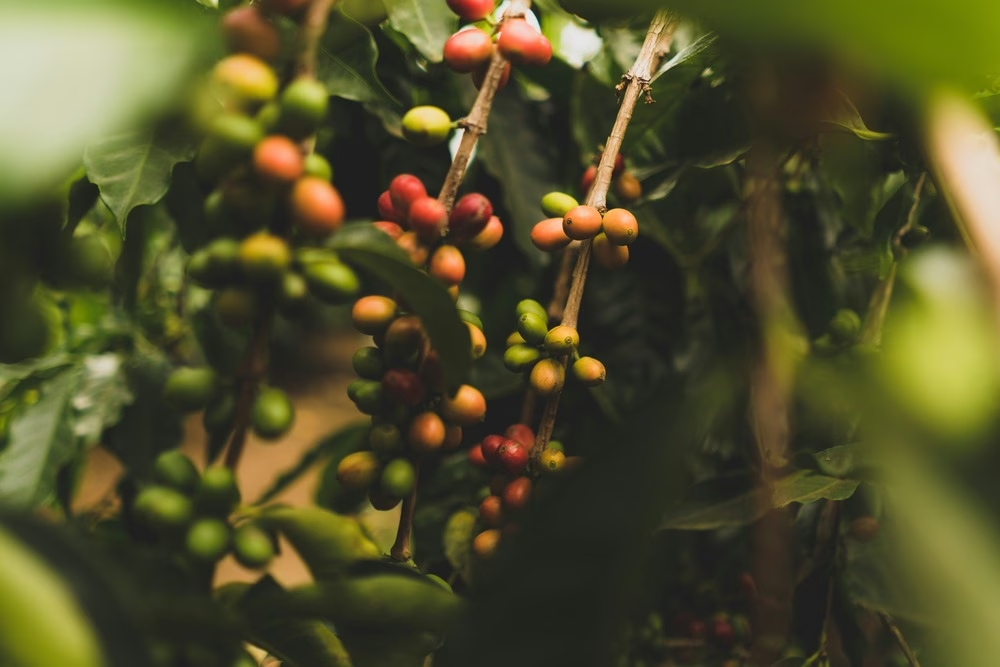
Scientific research has shown that shade-grown coffee systems can enhance climate resilience, contribute to carbon sequestration, conserve biodiversity, and improve farmer livelihoods through income diversification and food security.
Despite growing evidence to support agroforestry as an answer to the coffee industry’s most pressing issues, different regions and research institutions are often divided on best agroforestry practices, limiting practical application—and the Coffee Agroforestry E-Library hopes to bridge this divide.
From Fragmented Research to Open Access
The Coffee Agroforestry E-Library brings together peer-reviewed studies, technical reports, and manuals into a centralized, searchable database designed for farmers, companies, NGOs, policymakers, and researchers alike. Its open-access format ensures that critical scientific findings are available to stakeholders across the coffee value chain, from those engaged in farm-level decision-making to others focused on international policy development.
“This e-library is a game-changer for the coffee sector,” Etelle Higonnet, Director of Coffee Watch, shared in a press release. “By making the science accessible, we can accelerate the transition to coffee landscapes that are shade-grown, climate-resilient, and farmer-centered.”

What the E-Library Covers
The Coffee Agroforestry E-Library encompasses a broad range of topics relevant to the design and management of agroforestry systems. Key areas include climate change adaptation and mitigation, carbon storage, biodiversity outcomes, soil health, water conservation, and soil moisture management.
The online resource also addresses pressing social issues within the industry, such as farmer income diversification and ensuring food security within producing communities.
Adapting to a Changing Climate
Eduardo Somarriba of CATIE, who oversaw the development of the Coffee Agroforestry E-Library, emphasizes the database’s importance in ensuring a sustainable future for the industry. “Anyone who wants to grow, sell, buy, or drink sustainable coffee should read the library,” he says.
Eduardo also shares an alarming truth and how the database is working to address it: “Scientists say half of global coffee will vanish by 2050 if we don’t make major strides towards climate-proofing our coffee. If we want to save coffee from climate change, agroforestry is a crucial solution, and this E-Library explains everything you need to know about it.”
A Living Resource
Most importantly, the Coffee Agroforestry E-Library is designed to be a “living resource,” with new research added over time, ensuring the database continues to reflect advances in both research and on-the-ground work.
As the global coffee community seeks responses to climate and economic pressures, this new platform provides a strong starting point for ensuring a more sustainable industry through advancing shade-grown coffee systems worldwide.

Subscribe and More!
As always, you can read Barista Magazine in paper by subscribing or ordering an issue.
Support Barista Magazine with a Membership.
Signup for our weekly newsletter.
Read the December 2025 + January 2026 Issue for free with our digital edition.