
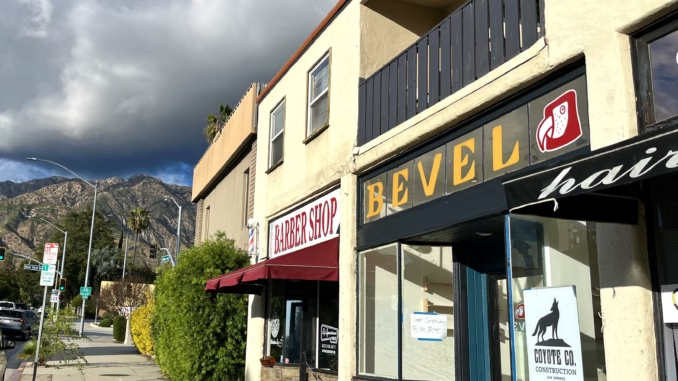
While much of Los Angeles has moved on from the Eaton and Palisades fires, communities in the burn scars are still recovering.
BY MELINA DEVONEY
BARISTA MAGAZINE ONLINE
Photos courtesy of Melina Devoney unless otherwise noted.
A year ago, we published Café Owners Rebuild After the L.A. Wildfires. After news coverage of the anniversary of California’s second and third most destructive wildfires in history resurged and waned, we caught up with café owners Frank Kim of Highlight Coffee, Kevin Mejia of Bevel Coffee, and Mark Wain of Caffe Luxxe.
Just like every other year, Highlight Coffee in Altadena, Los Angeles, set out a collection box last holiday season for café-goers to donate presents to those in need. In previous years, it would have been overflowing with donations. This year, the box remained empty. By no means did this reflect the giving spirit of Altadena, but rather a recovering community that had nothing left to give.
The empty box is just one symbol that life in the burn scars is still far from normal. Neighboring cities just outside of the affected areas are a “different world” where life goes on as usual, says Frank Kim of Highlight Coffee. “Here, regular life is very different. There is no regular life.”

Twelve people died and more than 6,800 structures were destroyed in the Palisades Fire, and 19 people died and 9,400 structures were destroyed in the Eaton Fire. Most properties are finally cleaned up, but many remain completely flattened—an unimaginable scene until you stand in front of an excavated lot.
Frank, who lives with his wife and toddler in Altadena, is not alone in feeling anxiety resurface with each forecast of rainstorms or high winds across the vulnerable landscape. His family has moved seven times. “We had a couple hotels; we’ve been in Airbnbs, apartments, my parents’,” Frank says. “I’m still dealing with lead at my house. I literally just got to sleep on my bed for the first time a couple days ago.”
Highlight opened its doors as soon as possible for neighbors last February, and has since stretched out its insurance claims, relief grants, and fundraisers as long as it could. Frank isn’t holding out hope for further recovery assistance as most grants and charity donations have run out. “At a certain point you just kind of give up,” Frank says.
Last year, Highlight’s customers were mostly clean-up crews and uprooted residents in limbo. Now, foot traffic has picked up from residents who are ping-ponging between rental homes or visiting to rebuild their damaged homes. Frank is grateful for the steady, albeit slower, flow of local customers. “There isn’t really much you can do to force people to come here and spend more money,” Frank says. “I know in the long term, we’ll have a lot more people up here, but that might be five-plus years from now—and that sounds kind of scary to have to wait that long.”
Frank doesn’t expect most people to be living in permanent homes for years, and, he says, even then, “it’s gonna be a whole new set of residents.” Rebuilding has been too expensive and extensive for many residents to justify.
“What I really, really yearn for is stability—any sort of stability where things aren’t constantly changing and you’re not having to scramble and figure stuff out,” Frank says.
Frank emphasizes the need for community-driven recovery and stability; he’s been “irked” by people from outside the fire-affected areas coming in “to make this neighborhood better.” Frank has witnessed a disconnect between what the “do–gooders” offer and what the community needs.
“It’s kind of strange when someone comes in without the understanding. You can’t expect them to understand because they didn’t go through it,” Frank says.
Instead, local business owners have found solace in banning together. Local café owners have been rooting for each other to reopen so their respective regulars get their third space back.
“Earlier on, we had a coalition of local businesses that would keep each other informed about government help or grants, and try to promote each other,” Frank says. “That part’s been nice because a lot of us never really got to know each other (before the fires).”
Small businesses owners have much to commiserate about; the fires came in a series of blows to the LA hospitality sector since 2020: the COVID-19 pandemic, Hollywood strikes, ICE raids, and tariffs on green coffee imports. A corporate coffee chain opened in Altadena in 2024, hurting the local coffee scene further.
Even as a highly-regarded, normally busy coffee shop, “the success is not very lucrative,” Frank says. “There has to be other reasons besides me wanting to make money.”
This decade’s challenges have amplified Frank’s sole raison d’être as a coffee shop owner: “to create that sense of community that a lot of people feel a coffee shop does,” he says.
For Frank, Highlight’s core mission now goes beyond building community. Surrounded by vacant lots and newly-constructed buildings, Highlight is a relic of the past that momentarily transports customers back to familiarity. “When someone comes back, they could feel like part of their old home is still here,” Frank says.
“We’re literally a piece of home that survives something that pretty much the entire world will never really experience,” Frank says. “A lot of us are able to support each other just because we understand each other a little bit better.” Frank finds the motivation to come to work every day from serving customers who he can empathize with. “It’s almost impossible to really have that empathy,” Frank says. “I’m glad I could be someone that can understand.”

Bevel Coffee’s pop-up at Prime Pizza in Altadena has also been kept busy by supportive residents.
“People that are still displaced are still really making an effort to come to Altadena,” Kevin Mejia of Bevel says. “You can see people being supportive in how they interact with us and also how they tip us.”
Kevin continues to feel a duty to provide Altadena residents with a third space of normalcy.
“Every time someone shows up, I’m always thinking ‘how can we make this person feel good?’ That’s become my little mantra,” Kevin says.
Because of reciprocal community support, some damaged and destroyed Altadena businesses were able to reopen. Bevel is opening a brick-and-mortar February 28. “It would not have been possible for a long time had the fires not happened,” Kevin says. “This in some ways fast tracked us.”
In a much-needed stroke of luck, a 600-square foot unit opened up across the street from Prime Pizza last summer. “Our customers at Prime can continue to be our customers at the new space, which was the target to begin with,” Kevin says.

They took over the space in July and were permitted to build by November. Small business loans and fire relief grants helped Bevel cover costs of the build-out.
“The city and the county and people in Altadena are really trying to support the impacted businesses,” Kevin says. “We would’ve had to be knee deep in loans to make it happen otherwise.”
Building out a café puts Kevin in the shoes of his neighboring business owners who did so years ago, just to have it all ripped away.
“Because we get to build out, because we get to continue to serve the community, it’s almost my duty,” Kevin says. “I want to because so many people and so many businesses can’t right now.”
Kevin plans to donate proceeds from a dedicated coffee to local causes.
After a hard hit from the Palisades Fire, Caffe Luxxe is bouncing back in a new direction.
The roaster and coffee chain is still rebuilding its burned-down Palisades location. In the meantime, it has been offering free coffee to first responders and on the streets of the Palisades.
Its Malibu location, which was inaccessible via the Pacific Coast Highway until last April, reopened in May.
Unrelated to the fires, luxury candy company Sugarfina acquired Caffe Luxxe last December. Mark Wain and his co-founder Gary Chau will lead the company for at least the next three years.
“It started as a discussion of bringing their amazing, premium candy to our customers,” Mark says. “The discussions morphed into company philosophy, leadership and team development, and future vision, and one thing led to another and the idea to ‘team up’ was brought up. Their leadership are/were longtime Caffe Luxxe customers, and understand what we do, what makes us special, and appreciate the intentionality in everything we do … just like they do.”
Caffe Luxxe will open a new location in Culver City this year.
ABOUT THE AUTHOR
Melina Devoney (she/her) is a barista and freelance writer in Los Angeles zeroed in on coffee and agriculture. She aims to amplify the voices of farmers and a diversity of perspectives within the coffee industry, and she’s happiest when running on wooded trails and dancing at concerts.

Subscribe and More!
As always, you can read Barista Magazine in paper by subscribing or ordering an issue.
Support Barista Magazine with a Membership.
Signup for our weekly newsletter.
Read the February + March 2026 Issue for free with our digital edition.
For free access to more than five years’ worth of issues, visit our digital edition archives here.