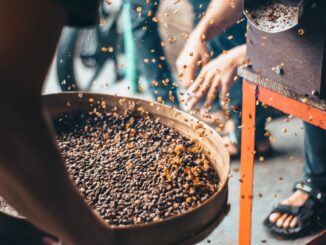

In Uasin Gishu County, Kenya, unions are providing small-scale coffee producers with essential resources.
BY OGLAH MOROGO
BARISTA MAGAZINE ONLINE
Featured photo: Uasin Gishu County Governor Jonathan Bii Chelilim holds discussions with officials of the Uasin Gishu Coffee Farmers Cooperative Union at a coffee buying and milling center. Photos courtesy of Uasin Gishu County Government.
What to know:
- Cooperatives in Uasin Gishu County, Kenya, are helping small-scale coffee farmers access government support, resources, and services more easily, which has improved their productivity and economic stability
- These cooperatives provide critical services such as farmer education, access to modern farming tools, affordable credit, and equipment, and bulk purchasing of agricultural inputs, which has reduced costs and improved coffee quality
In Kenya’s still-developing coffee sector, farmers’ reliance on cooperatives remains strong. In Uasin Gishu County, these unions are enabling small-scale farmers to increase output, improve coffee quality, and achieve greater economic stability. Through their work, cooperatives have become main actors in the county’s coffee sector by aiding farmers to access government facilities, learning opportunities, modern farming tools, low-cost farm inputs, and financial services.
Simplifying access to government support
Ruth Samoei, Uasin Gishu County’s Chief Officer of Cooperatives, notes that farmers who belong to cooperatives access government assistance more easily than those operating independently. Local and national government programs often work more closely with organized farmer groups when distributing subsidies, farm supplies, and agricultural services.
Through this system, more farmers benefit from resources that might otherwise be difficult to obtain individually. Cooperative structures also help improve accountability and ensure support reaches intended beneficiaries.

Addressing the challenges of working alone
For many farmers in Uasin Gishu County, working alone has meant facing numerous challenges, including restricted access to important resources and opportunities. Cooperatives have been a game changer because they allow farmers to come together as a much stronger force. These organizations negotiate services at improved rates for their members and bring in support from outside bodies. “Cooperatives have become the primary conduit for farmers to the government’s agricultural programs that are geared towards increasing productivity,” says Ruth.
Educating farmers
Farmer education is among the most critical services that cooperatives provide. Growing coffee is a complex science, especially as producers adjust to climate change, evolving market needs, and more stringent quality requirements in global markets. Through cooperatives, farmers participate in county agricultural extension programs and meet one-on-one with county extension officers who teach up-to-date coffee practices.
This education enables farmers to raise production without compromising quality. It also promotes environmentally friendly farming that replenishes the earth while preserving the farm’s ability to produce in the future.

High-quality equipment leads to less waste
Joseph Kurgat, Chairman of the Uasin Gishu Farmers Cooperative Union, says cooperatives are also helping cut waste by providing access to farm machinery and common processing facilities. New technology for drying and pulping, as well as improved standards for storage and transport, have brought improvements in post-harvest handling of coffee across the region.
Poor post-harvest processing lowers coffee quality and the price it fetches. Through cooperatives, farmers now share the cost of equipment instead of shouldering the entire expense alone. Upgraded equipment leads to greater consistency and enables farmers to achieve the quality thresholds necessary to sell through specialty coffee channels, which often provide opportunities to connect with buyers who pay premium prices.
Reduced costs through bulk purchasing
Increasing coffee production costs still plague many farmers in Kenya. Cooperatives reduce these costs by bulk buying fertilizers, pesticides, farm equipment, and other agricultural inputs. When shopping in bulk, cooperatives bargain for the best prices and quality for their members. This eases the financial strain on smallholder farmers and shields them from fake agricultural products, which can devastate crops and result in lower yields.
Better market opportunities and increased profits
Stable market access remains one of the greatest difficulties for coffee farmers. Individual sellers can fall prey to brokers and middlemen who lowball coffee prices. Cooperatives have stronger bargaining power through collective marketing and product aggregation. This gives them more power to negotiate with buyers, exporters, and processors. Cooperatives also enable better traceability—a major requirement in specialty coffee. As a result of joining forces, farmers access stronger markets and higher margins.
Financial security through affordable credit
Historically, many smallholder farmers have been unable to access affordable financial services from commercial banks due to limited collateral and seasonally fluctuating income. Savings and Credit Cooperative Organizations (SACCOs) are addressing this challenge by providing savings and credit services at lower cost. Affordable credit enables farm households to make long-term investments, and savings services allow them to smooth consumption and improve farm production techniques.
The future of coffee farming in Uasin Gishu County
As Kenya builds its presence in the global coffee market, cooperatives remain essential in enabling small-scale farmers to take part in more profitable and sustainable coffee production. In Uasin Gishu County, these groups are already working with farmers to develop a more robust coffee industry. By providing training, access to affordable inputs, new equipment, improved market linkages, and financial services, cooperatives are fostering an enabling environment for coffee farmers. Their achievements provide a hopeful template for the future of Kenya’s coffee industry.
ABOUT THE AUTHOR
Oglah Morogo is a freelance writer and emerging coffee farmer based in Ainabkoi Constituency, Uasin Gishu County, Kenya. A third-generation farmer, she combines inherited agricultural knowledge with a growing passion for coffee and commercial farming of wheat and maize.

Subscribe and More!
As always, you can enjoy your own copy of Barista Magazine by subscribing or ordering an issue. Long live physical media!
Support Barista Magazine and show your love with a Membership.
Signup for our weekly newsletter.
Join us at Camp Coffee Shop Aug. 10-13 in Napa, California.
Read the June + July 2026 Issue for free with our digital edition.