We learn more about VA, the digital tool delivering crucial agronomic guidance to smallholder farmers in Africa.
BY DANIEL MURAGA
BARISTA MAGAZINE ONLINE
Photos courtesy of Virtual Agronomist unless otherwise noted
What to know:
- In Africa, “digital agriculture” is reshaping how young people see farming, with apps and other digital tools modernizing the sector and attracting a new generation of producers
- Virtual Agronomist is a digital tool helping smallholder coffee farmers in Africa by providing them with agronomic guidance and data-driven soil insights
- The chatbot, which is operated through WhatsApp, is free for smallholder farmers and provides them with tailored nutrient plans, planting guidance, and coffee pest and disease alerts—helping them maximize their harvests + profits
As the use of artificial intelligence (AI) expands at rapid speeds around the globe, so does some level of hesitation, with many wondering how technology will impact coffee workers along the supply chain. But one digital tool, Virtual Agronomist (VA), is showing how technology can be used to benefit communities at origin—by making information more accessible than ever before.
Alice, a coffee farmer in Kenya, has a seven-year-old coffee farm with established trees and has been applying fertilizer the way other farmers in her area have always done it: buying what’s available locally and applying it by instinct rather than by what her soil actually needs. She knows that soil is the foundation of crop production, and yet, she and most smallholder farmers lack access to reliable information on the nutrient status of their fields.

To Alice and her cohorts, laboratory soil testing is often prohibitively expensive, and alternative services frequently delay results or fail to return them altogether. Fortunately, Virtual Agronomist is promising to replace instinct and guesswork with scientific certainty by providing instant, data-driven soil insights.
Innovative Solutions for Decision Agriculture (iSDA), the company behind the development of VA, was founded in 2018 by three research institutions—Rothamsted Research, the World Agroforestry Centre, and the International Institute of Tropical Agriculture—to carry forward the legacy of the African Soils Information Service, which spent over a decade collecting and analyzing more than 50,000 soil samples across the continent.
“Our mission is to deliver expert agronomic advice to every smallholder farmer in Africa. We achieve this through two core innovations: iSDASoil, a continent-wide soil map at 30-metre resolution, and Virtual Agronomist (VA), an AI-powered advisory tool that translates this data into site-specific recommendations delivered directly to farmers via WhatsApp,” Bruce Kisitu, the company’s Director of Operations, tells Barista Magazine.

Bruce notes that the coffee that we drink starts with a decision a farmer made about their soil—whether they knew what their soil needed or had access to the right advice at the right time. All of that shapes what ends up in the roaster and ultimately, in the cup.
For too long, that first decision has been made in the dark, with farmers like Alice working with incomplete information, applying fertilizer by habit rather than by need, and managing pests and diseases without timely guidance.
VA technology in action
In Africa, digital agriculture is reshaping how young people see farming. Drones, climate apps, and mobile advisory platforms like VA are making agriculture look cool, profitable, and modern.
As Bruce tells us, VA is an AI-enabled chatbot that delivers a suite of services providing tailored agronomic advice to farmers. It was initially developed as a mobile application, but it faced challenges in scaling effectively. The advancement of AI created an opportunity to redesign and relaunch the solution as a chatbot in 2024, significantly improving accessibility, usability, and reach. Today, VA delivers crop- and plot-specific recommendations directly to farmers through WhatsApp.
“What makes VA different from generic AI tools is the engine underneath,” Bruce explains. “It combines iSDAsoil’s continent-scale soil data with deterministic agronomic models, meaning recommendations are scientifically grounded, not generated by guesswork. Farmers receive tailored nutrient plans, planting guidance, pest and disease alerts, and seasonal advice all calibrated to their specific plot location, soil type, and crop.”
Use of Bayesian network technique in coffee
According to Bruce, VA works differently from a generic AI chatbot. The conversational layer that understands a farmer’s question and responds in plain language is powered by a large language model (LLM), but the actual agronomic recommendations come from a set of scientific models built from curated agronomic research and literature using a technique called Bayesian networks to calculate the best advice, making it precise.
“Think of it this way: the LLM is the translator and the Bayesian network is the agronomist. A farmer starts a conversation on WhatsApp, and the translator guides them through a series of questions—what crop they’re growing, the size of their plot, their target yield, whether they’ve used manure, and what they’ve grown before. Simultaneously, the system pulls soil data for that exact plot location from iSDAsoil,” says Bruce.
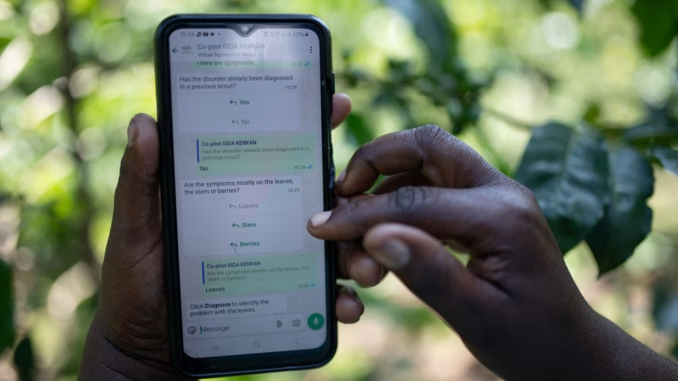
All that information is then handed to the agronomist tool, which weighs everything it knows about the farmer’s soil and crop and then calculates the most appropriate recommendation for that specific farm. As a result, the output isn’t a generic suggestion. It may be a tailored fertilizer plan specifying the exact nutrients that the soil needs, advice on when to plant based on the rain forecast, soil type, or crop health diagnosis.
The system also has a cloud scheduler that then sends timely reminders throughout the season— planting, emergence, topdressing, harvest—so advice comes at when it’s actually needed, not just once at the start of the season. The whole system runs on WhatsApp, which means there is no new app to download and no unfamiliar interface to learn.
“Reach is extended through a lead farmer model: trained community farmers carry VA recommendations to neighboring smallholders who may not have smartphones, bridging the digital and literacy gaps that often limit last-mile delivery. The result is effective agronomic advisory at a cost 10 to 20 times lower than traditional extension programs,” Bruce says.
Alice in the magical wonderland of Virtual Agronomist
Alice’s first interaction with VA came through a lead farmer who visited her farm, introduced the tool, and used it on the spot. The lead farmer opened WhatsApp and captured Alice’s coffee plot location by walking all the corners. From that GPS point, the system immediately pulled soil property data from iSDAsoil (the nutrient levels, pH, soil texture, and constraints specific to that exact plot). Alice needed no lab visits or soil sampling kits; the data was all there for her to use. VA then asked her a series of questions:
- What is your crop?
- What is your coffee variety?
- How big is the plot under coffee cultivation?
- Have you applied manure before?
- What’s your target coffee yield?
Alice answered through the lead farmer, and all the information was fed into the decision engine, which calculated a tailored recommendation.
For an established coffee tree like hers, the output included a specific NPK fertilizer blend with the exact ratio of nitrogen, phosphorus, and potassium the soil was missing, along with guidance on application timing and quantities for the plot.
“If her trees were younger than two years,” Bruce explains, “the system would have taken a different approach. It would have recommended manure rather than synthetic fertilizer, because young coffee roots are sensitive to fertilizer burn. The system knows this distinction and applies it automatically.”
Beyond nutrient management, VA also supports end-to-end decision-making throughout the cropping cycle. The cloud scheduler sends timely reminders via WhatsApp, alerting the farmer when to top-dress, when to scout for pests and diseases, and what to look for. The system also lets farmers to also send photos of their crop directly through WhatsApp and receive a pest or disease diagnosis in response. In addition, the system estimates target yields and potential profits to empower farmers to make informed, economically sound decisions.
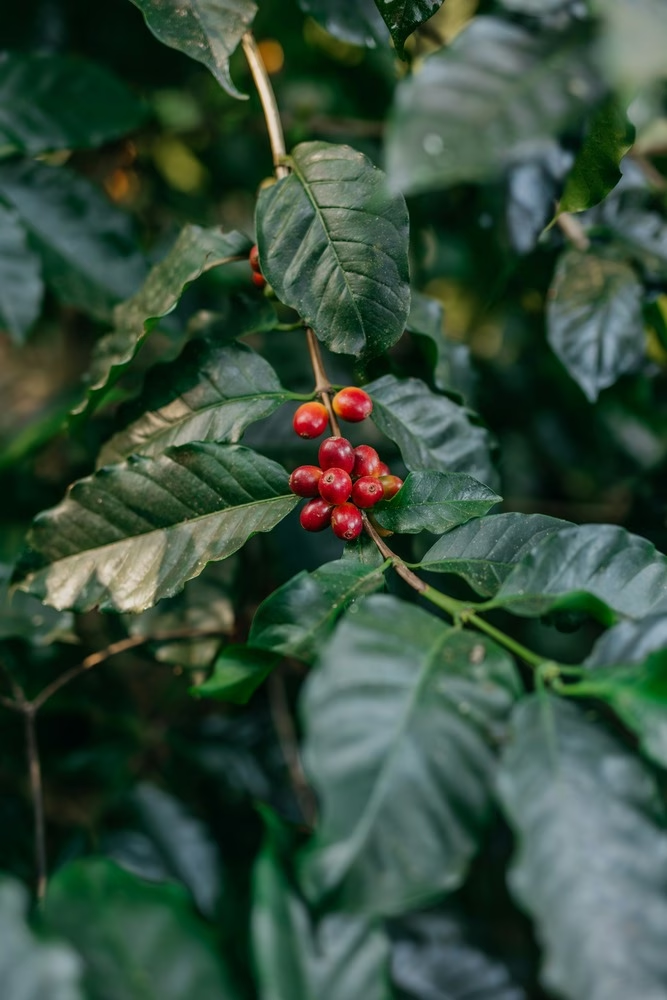
“Alice’s experience reflects what we saw across the 2025 survey cohort: after applying VA’s recommendations, she reported visibly healthier berries compared to her previous seasons. That visible improvement was what convinced her the advice was working, before she’d even harvested,” Bruce says.

VA is free for smallholder farmers
For smallholder farmers, Virtual Agronomist is free at the point of use. Bruce says the cost of delivering agronomic advice (currently $1.15 per plot per season) is covered through a combination of grant funding and partnerships with NGOs, input suppliers, and extension services who integrate VA into their existing farmer networks.
“The primary route to access VA is through the lead farmers, who bridge the smartphone and literacy gaps that would otherwise limit reach. Farmers who have smartphones and WhatsApp access can also engage with VA directly, and we actively encourage lead farmers to promote this,” says Bruce. “Once registered, a farmer’s plot is linked to their iSDAsoil data, and they receive tailored advice throughout the season via WhatsApp, primarily in English and increasingly in local languages. We have already developed versions in Kinyarwanda and Bambara, with more underway.”

Is VA phasing out traditional agronomic methods?
Bruce does not think traditional agronomic methods should be abandoned, because the knowledge and relationships built through human extension are invaluable. He says the problem is the reach. With extension agent-to-farmer ratios across Africa ranging from 1:3,000 to as high as 1:10,000, the reality is that most smallholder farmers rarely, if ever, receive a visit from an agronomist. When advice does arrive, it’s often infrequent, generalized, and not calibrated to the specific conditions of that farm.
He observes that for coffee farmers specifically, that gap is costly. This is because coffee is a perennial crop that requires precise, timely management across a long season. The wrong fertilizer, applied at the wrong time, can do more harm than good. What VA brings is specific advice to each farmer’s soil, their coffee variety, and their plot conditions, delivered at the moment when it is needed rather than when an extension agent happens to be available.
VA’s foundation technology is open-source and extendable
VA currently supports 24 crops in eight African countries, including coffee (both Arabica and Robusta varieties), maize, rice (upland, lowland, and ratoon varieties), Irish potato, cotton, sugarcane, sunflower, and a range of other grains, legumes, and tubers. This selection covers the staple and cash crops that matter most to smallholder farmers across the company’s current operating geographies and is extendable.
“What we’d want Barista Magazine‘s audience to know is that the foundation underpinning all of this—iSDAsoil, the soil data that powers every recommendation VA makes—is free and open to anyone, including researchers, developers, other platforms, and governments,” Bruce says.
ABOUT THE AUTHOR
Daniel Muraga (he/him) is a communications expert, researcher, writer, and editor based in Kenya with over 10 years of experience in the industry. His mission is to highlight Africa’s contributions to the realms of science, technology, innovation, culture, food, and related fields. He has done extensive research and written widely in the coffee niche for Sprudge Media, as well as in related areas for Life & Thyme and CQ Researcher, among others. When not writing, he is always outdoors communing with nature. You can find him on Facebook, X, and LinkedIn.

Subscribe and More!
As always, you can get a hard copy of Barista Magazine by subscribing or ordering an issue.
Support Barista Magazine and show your love with a Membership.
Signup for our weekly newsletter.
Join us at Camp Coffee Shop Aug. 10-13 in Napa, California.
Read the April + May 2026 21st Anniversary Issue for free with our digital edition.
For free access to more than six years’ worth of issues, visit our digital edition archives here.