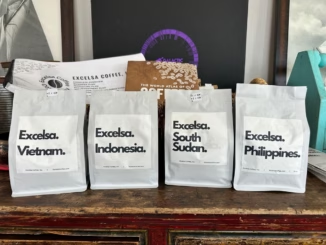

A look at the Excelling in Excelsa Coffee Project: an initiative with hopes to revive South Sudan and bring peace to the region through agriculture.
BY DANIEL MURAGA
BARISTA MAGAZINE ONLINE
Photos courtesy of Equatoria Teak Company
More than a decade after gaining independence from Sudan, South Sudan is still grappling with border, land, and civil conflicts, among other ills. However, there is a small piece of good news amid all the conflict: A new wave of investment in agriculture is promising to provide livelihoods and promote peace. Experts have long argued that sustainable agriculture, particularly in coffee, can be an important building block for peace and development in Africa.
Moving away from a war economy
Conflict-ravaged South Sudan has abundant oil, minerals, and other natural resources, igniting the myth of Africa’s “resource curse,” referring to how countries with natural resources have been torn apart by conflict and corruption in Africa and other developing nations. Despite this, experts like John Prendergast, founder of Enough Project—a nonprofit that fights genocide and crimes against humanity—believe that alternative wealth-generating opportunities can sustain livelihoods. “Specialized agriculture like coffee can benefit communities directly without the corrupt state intercepting the benefits, thus moving incentives away from the war economy,” John notes.
The civil war that erupted just two years after independence and was largely fought along ethnic lines resulted in the deaths of an estimated 400,000 and more than 2.5 million locally displaced persons. Currently, conflicts associated with cattle raiding, land access, political representation, and revenge attacks are rampant. However, wealth-creating and sustainable projects can greatly divert attention back to peace.

Coffee farming for prosperity and development
Historically, major economic activity in South Sudan has had little or no economic value to the local population. For example, mining has been largely exploitative, the oil industry has provided little local employment, and most subsistence agricultural activities have not only been inadequate to feed families, but have also ended up driving young people to urban centers, or worse, to militias in search of a prospective livelihood.
Currently, coffee farming in South Sudan, a sector that had virtually been wiped out by conflict, is offering communities in the hills and mountains of Equatoria a level of prosperity and development never before experienced in rural areas of the country.
Nespresso and TechnoServe‘s investment in South Sudan’s coffee sector is helping pave the way for a future South Sudan built on peace and prosperity, where wealth is created and shared for the benefit of the people. These projects shift the focus from war to activities that promote wealth-creation and peaceful coexistence.
Adding to these, Excelling in Excelsa—a project by the Food and Agricultural Organization (FAO) of the United Nations in South Sudan, Hummingbird Action for Peace and Development, Interchurch Coordination Committee Development Aid (ICCO) Cooperation, and Equatoria Teak Company (ETC)—is adding a sweet taste to the brew. The project was founded to initially provide 1,000 contract farmers with training, extension services, and access to quality inputs, enabling them to produce Excelsa coffee to international standards. In doing so, the initiative is creating new jobs (targeting women and younger farmers) and adding 190 additional farm positions.
“Excelling in Excelsa Coffee Project is a private-public partnership to revive the coffee origins of South Sudan, especially in two counties of the Western Equatoria region (Nzara and Yambio),” says Ian Paterson, Managing Director at ETC. “The project aims at improving livelihoods, especially for women and youth, by providing sustainable income using Excelsa coffee, a rare coffee variety native to the region.”
ETC is South Sudan’s leading and Africa’s second-largest sustainable teak operation company. Between 2015 and 2020, the company focused on harvesting teak from its plantations. But teak takes 25 years to mature, making it necessary for the community to look for an alternative, more immediate source of income in the interim. With this realization, the company took a new direction.
“In 2020, ETC launched the Excelling in Excelsa coffee initiative with support from the Netherlands Enterprise Agency. This wasn’t just a commercial project; it was a vision to create long-term benefits for communities in Nzara and Yambio counties. We built a growing network of over 1,500 outgrower farmers—40% of whom are women—along with creating more than 190 direct jobs, with a commitment to gender equality, as 50% of those jobs are held by women,” Ian says.
The Equatoria region in South Sudan is perfect for coffee due to its topography that features the Imatong mountains and Mount Kinyeti, with an equatorial climate and dense forests. The main coffee variety here is Excelsa, which is one of the world’s four major coffee varieties that represents an estimated 7% of global coffee production.

Nurturing livelihoods and preserving heritage
According to Ian, ETC’s coffee project isn’t just about cultivating coffee; it’s about nurturing livelihoods, preserving heritage, and building a more sustainable future for generations to come. He agrees that peace, stability, and development will prevail if people are busy with income-generating projects such as sustainable agriculture in coffee. There will be fewer wrangles and conflicts because all initiatives that bring stability to the rural economy are directly linked to peace.
King of the Azande people in South Sudan Peni Rikito Gbudue concurs with the fact that projects like Excelling in Excelsa are perfect vehicles for peace by recently remarking that ETC “planted peace, not just coffee.” This is a clear testament that Excelling in Excelsa is acting as a strategic tool for fostering stability and economic development, by offering farmers a sustainable livelihood alternative to conflict.
The project primarily focuses on the Excelsa coffee variety, planted across over 178 acres of its own farms and another 1,360 acres managed by outgrowers. According to Ian, the results so far are promising. They harvested around five tons in 2025 and expect that to grow to 20 tons by the end of 2026. They are already roasting and selling locally in supermarkets and hotels in South Sudan’s capital, Juba, and have initiated conversations with international buyers such as Volcafe, Union Coffee, and Omwani. Cupping results have been encouraging too, consistently scoring above 80, confirming the quality and potential of their beans.
“Our goal is ambitious yet achievable: By 2031, we aim to export 500 metric tons of coffee annually, generating $1.5 million in revenue for local communities,” Ian says.
ABOUT THE AUTHOR
Daniel Muraga (he/him) is a communications expert, researcher, writer, and editor based in Kenya with over 10 years of experience in the industry. His mission is to highlight Africa’s contributions to the realms of science, technology, innovation, culture, food, and related fields. He has done extensive research and written widely in the coffee niche for Sprudge Media, as well as in related areas for Life & Thyme and CQ Researcher, among others. When not writing, he is always outdoors communing with nature. You can find him on Facebook, X, and LinkedIn.

Subscribe and More!
As always, you can read Barista Magazine in paper by subscribing or ordering an issue.
Support Barista Magazine with a Membership.
Signup for our weekly newsletter.
Read the February + March 2026 Issue for free with our digital edition.
For free access to more than five years’ worth of issues, visit our digital edition archives here.