The fully manual 58mm portable espresso machine offers real pressure control, mechanical yield precision, and impressive shot quality.
BY VASILEIA FANARIOTI
SENIOR ONLINE CORRESPONDENT
Featured photo courtesy of emanuale. All other photos by Vasileia Fanarioti.
Portable espresso makers often promise café-quality results but land somewhere adjacent to true espresso. The emanuale takes a different approach.
Designed by Jakob Diezinger and Katrin Homberg, this fully manual machine is built around standard 58mm baskets. That single decision immediately signals its intent: This is not a shortcut device. It expects you to bring skill, attention, and curiosity. What it offers in return is control.

First Impressions: A Machine Built With Purpose
The experience begins with packaging that doubles as function. The machine arrives in a sealed metal canister that serves as both protective case and airtight storage for either the device or coffee beans. It’s practical, durable, and visually distinctive—an early hint that design and usability are tightly linked.
Out of the canister, the first thing you notice is the weight. For a portable espresso maker, it feels substantial. Some may call it heavy; I experienced it as reassuring. There’s no hollowness, no flex. The machining is clean, tolerances are tight, and components lock together with precision. It feels mechanical in the best sense of the word.

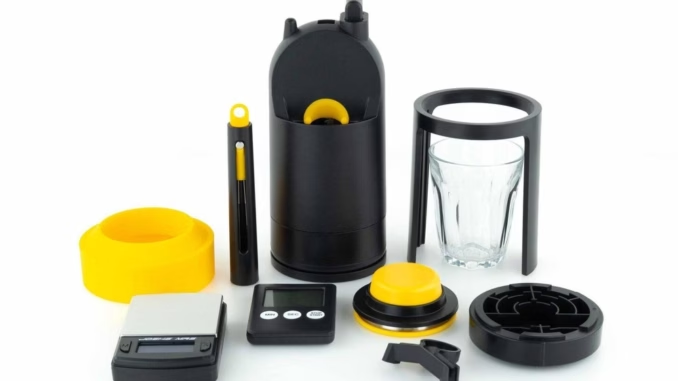
In the box you’ll find:
- 58mm IMS Competition basket (17–21g)
- Puck screen
- Dosing ring
- Integrated WDT/distributor tool
- Flat-base tamper
- Crank with built-in pressure scale
- Drip tray
The integrated WDT tool stands out. With the press of a button, needles deploy for distribution, then retract and magnetically snap back into place. No loose accessories, no extra clutter. It’s a small detail that improves workflow significantly.
Aesthetically, the emanuale leans industrial and minimalist—brushed metal, exposed mechanics, no decorative excess. It looks equally natural on a café bar, kitchen counter, or camp table.

Workflow: Fully Manual, Fully Engaged
The emanuale does not simplify espresso; it makes you part of it.
To begin, you raise the piston by turning the crank counterclockwise, which opens the internal valve. Preheating is essential. Hot water is poured through the chamber and discarded before adding fresh water for brewing. There’s also an optional preheat ring that allows the machine to sit directly on a kettle for deeper thermal saturation.
Temperature management matters here. Without adequate preheating, consistency suffers. With it, results stabilize quickly.
The manufacturer mentioned that the machine needs a few shots to fully settle in. That proved accurate. The first couple of extractions felt like a break-in period—for both the seals and for me. After that, resistance became smoother and more predictable, and the workflow found its rhythm.

Mechanical Feedback: Pressure and Yield Without Electronics
Instead of a traditional needle gauge, pressure is displayed directly on the crank. Around the base of the handle is a colored pressure scale with clearly marked bar levels. As you rotate and apply force, you see exactly where you are within that range. The colored zones provide quick reference; the numbers allow precision.
Next to it sits the Smart Ratio Scale (SRS), sometimes referred to as the Liquidmeter. This is a mechanical yield system. Before brewing, you rotate the crank counterclockwise to set a specific number of piston turns. That setting determines how much water will pass through the coffee before extraction ends.

In practical terms:
- The crank scale tells you how hard you’re pushing (pressure).
- The SRS tells you how much you’ll extract (yield).
During the shot, the system tracks piston travel internally. When your preset endpoint is reached, you hear a distinct “bing.” That sound marks the end of extraction. Once you dial in a setting that works, those turn numbers become reliable reference points. It’s controlled without feeling automated.

Testing the emanuale
Scenario 1: 18g Basket, Classic Double
I started with the included 18g basket, medium roast, finely ground with a hand grinder. After thorough preheating, I targeted a 1:2 ratio.
The extraction was slow and even. Watching pressure build while keeping the indicator in the blue zone made the process tactile and immersive. The audible endpoint aligned closely with my target yield.
The result: dense crema, excellent body, and clarity that exceeded my expectations for a portable device.

Scenario 2: Double-Spout Configuration
Using the double-spout setup, the machine shines as a two-singles brewer. With the same basket, I split shots evenly into two cups, achieving consistent volume and crema in both.
This configuration isn’t meant for pulling a large double into a single cup. The basket performs best extracting up to about 65–70ml in one full run. Used as intended, it delivers balanced and repeatable results.
Scenario 3: Bottomless With a 14g Basket
Switching to a 14g basket and running bottomless opened new possibilities. This setup allowed for a larger single without maxing out chamber volume.
It also removed any forgiveness. Grind inconsistencies became immediately visible. Channeling showed itself clearly. The emanuale doesn’t hide mistakes—but it rewards precision.

Scenario 4: Experimentation
Once comfortable, I explored further:
- Short ristretto-style shots with syrupy texture
- Longer extractions toward 60–65ml
- Lower-pressure pulls for lighter roasts
- Manual pre-infusion by briefly holding the piston open before building pressure
Because pressure and yield are mechanically visible, experimenting feels intuitive rather than intimidating. Small adjustments translate directly into observable changes.
The more I used it, the more capable it felt.

Portability vs. Performance
This is where the emanuale stands apart. Yes, it’s compact. No, it’s not ultralight. But that mass translates directly into stability and pressure consistency. Most portable espresso makers rely on pressurized systems or proprietary baskets. The emanuale uses standard 58mm baskets, which dramatically improves familiarity and shot quality.
From a results perspective, this is some of the best espresso I’ve tasted from a portable device. It feels less like a travel gadget and more like a downsized manual lever machine.
Who It’s For
If you enjoy dialing in variables and shaping your shot manually, the emanuale will feel right at home.
It is for:
- Espresso enthusiasts who enjoy hands-on brewing
- Professionals wanting a portable 58mm workflow
- Outdoor enthusiasts
- Anyone who values process as much as outcome
It rewards patience, experimentation, and attention to detail.

Final Thoughts
Using the emanuale is an experience rather than a shortcut. It demands proper grind size, temperature management, and mechanical awareness. There’s a learning curve, and the first few shots are part of that journey.
But once dialed in, the payoff is real espresso that’s balanced, nuanced, and repeatable. Portable doesn’t usually mean uncompromising. Here, it does—provided you’re willing to participate fully in the process. For those who see espresso as craft rather than convenience, the emanuale delivers something rare in the portable category: control without electronics, and performance without apology.
ABOUT THE AUTHOR
Vasileia Fanarioti (she/her) is a senior online correspondent for Barista Magazine and a freelance copywriter and editor with a primary focus on the coffee niche. She has also been a volunteer copywriter for the I’M NOT A BARISTA NPO, providing content to help educate people about baristas and their work.

Subscribe and More!
As always, you can read Barista Magazine in paper by subscribing or ordering an issue.
Support Barista Magazine with a Membership.
Signup for our weekly newsletter.
Read the February + March 2026 Issue for free with our digital edition.
For free access to more than five years’ worth of issues, visit our digital edition archives here.