
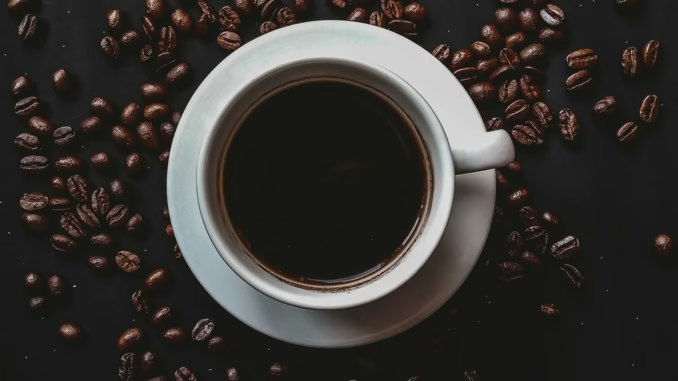
Health-conscious consumers have long debated whether or not coffee is “good” for you—but recent studies show that coffee can fit into a healthy lifestyle.
BY ANGEL CASTILLO
BARISTA MAGAZINE ONLINE
Featured photo courtesy of Indra Projects
So what’s the truth—is coffee healthy or not? While, for decades, health-conscious consumers have warned of the negative side effects of caffeine (mainly the familiar “jitters”), recent research actually shows that caffeine, when consumed in moderation, can have positive health benefits, including mood elevation, improved cognitive function, and even reduced risk of type 2 diabetes.
Today, we’ll take an in-depth look at these benefits and discuss how coffee can fit into a health-conscious lifestyle.
The Health Benefits of Caffeine
Have you ever felt a spark of joy from your first sip of coffee for the day? There’s a science behind that feeling that goes beyond the comfort of a daily ritual. In a recent study from the Australian & New Zealand Journal of Psychiatry, coffee was linked to mood elevation, helping to relieve symptoms of depression. This is because caffeine blocks adenosine receptors, causing the release of dopamine and leading to feelings of increased alertness and pleasure.
Furthermore, an article published by the American Health Association shares that caffeine can improve alertness, cognitive function, and even have positive effects on athletic function. Recent studies also show that daily coffee consumption can help lower the risk of type 2 diabetes, reduce inflammation, and slow down cellular aging.
Overall, a moderate level of caffeine can do more than fit into a healthy lifestyle—it can, surprisingly, aid to it. However, the amount of it and additives it is consumed with are what can be cause for concern.

Defining “In Moderation”
Moderation is the key to most things, and the same is true for caffeine. To be more specific, research from the FDA shows that less than 400mg of caffeine daily is best to receive its positive health benefits. That equates to a little over two 8-ounce cups of coffee.
Dr. Shannon Kilgore, a neurologist in Palo Alto, California, shared with the American Medical Association that coffee drinkers should treat caffeine should the same way they would any other over-the-counter drug: with awareness and a certain level of discipline.
“One of the things that people don’t realize is, if you think of it as a medicine, then the best way to use it is in small, frequent doses,” Dr. Kilgore says. “So, 20 milligrams to 100 milligrams at a time as opposed to the standard American mug of coffee. (You want to get) it into your brain a small amount at a time.”

Dr. Kilgore also notes that the amount of caffeine in brewed coffee varies depending on the type of bean, grind size, and brew time. A study conducted at Berry College by Assistant Professor of Physics Zachary Lindsey and analytical chemist Joshua Williams from Drexel University deemed medium-roast coffee as having the highest caffeine content yield after brewing: even more than light-roasts, which are commonly believed to have the highest levels.
While there are many benefits to caffeine, overindulgence can lead to serious side effects, including high blood pressure and rapid heart rate, the result of over-stimulation of the central nervous system and a release of adrenaline from the brain. Dr. Clark of the American Health Association puts it simply: “If you’re getting jittery, it’s too much caffeine.”
Addressing Differing Levels of Sensitivity
Some people are simply more sensitive to caffeine, pushing new companies like Caffeine Control to create coffee blends that can be enjoyed by these individuals and even women who are pregnant. Coffee with lower amounts of caffeine still retain the positive health benefits discussed in recent studies.
“We’ve all had days where caffeine makes us feel great, and days where it doesn’t,” Pete Licata, 2013 World Barista Champion and founder of Caffeine Control, shared with Barista Magazine this past April. “Caffeine Control is about putting that power into the hands of the drinker.”

Preparation Matters
The key to receiving the health benefits of caffeine also has to do with the coffee’s preparation. Cold brew typically has more caffeine due to longer brew times, which makes the effects of caffeine feel stronger than hot brewed coffee (which can be a good or a bad thing).
Sugar can also play a role, with a spike in glucose giving a similar sensation of caffeine but with a stronger “crash.” Some coffee lovers opt for salt in their coffee instead of sugar, which can help consumers avoid abrupt spikes and drops in energy.
A 2024 study conducted by Michael Greger, M.D., also shows that adding cow’s milk to coffee can actually reduce the body’s absorption of the antioxidants in coffee. Coffee contains a class of polyphenol phytonutrients found in beans called chlorogenic acids, which has been proven to lower acute blood pressure. When milk is added to coffee, the chlorogenic acid binds to milk proteins, lessening its ability to enter the blood stream. This was then tested with soy milk, which initially bonded with the chlorogenic acid—but, during digestion, the phytonutrients still made it to the bloodstream, allowing for the full health benefits from coffee.
A Health-Conscious Habit
A study conducted by the National Institutes of Health found that, overall, coffee drinkers tend to live longer than non-coffee drinkers. Whether this trend stems from the health benefits derived from the beans, or simply the ease of mind gained from a restful café moment, coffee lives on as a long-standing tradition across the world—and, in moderation, a guilt-free one.
ABOUT THE AUTHOR
An artist based in Los Angeles, Angel Castillo is host of a South American food pop-up, Gatitos Cocina. Their family has a history of growing coffee in Ecuador and continues an at-home practice in San Diego, California.

Subscribe and More!
As always, you can read Barista Magazine in paper by subscribing or ordering an issue.
Support Barista Magazine with a Membership.
Signup for our weekly newsletter.
Read the December 2025 + January 2026 Issue for free with our digital edition.
For free access to more than five years’ worth of issues, visit our digital edition archives here.