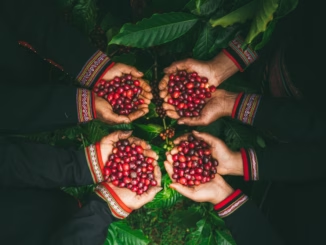

Would you try coffee that was harvested ten years ago? Roasters are experimenting with freezing green coffee, unlocking new possibilities for quality preservation.
BY EMILY JOY MENESES
ONLINE EDITOR
Photo by George Dagerotip
We’re all familiar with frozen produce—but what about frozen coffee? Over the past decade, a growing number of roasters have begun experimenting with freezing green coffee as a way to preserve freshness, extend buying power, and essentially “bend time,” allowing coffee drinkers to enjoy coffee that’s literally from decades past, with no sacrifice in quality.
Few have embraced the practice of freezing coffee as fully as Passenger Coffee, a Lancaster, Pa.–based company which recently released a Kenyan coffee harvested in 2016 that had been frozen since its arrival. And this isn’t their first time freezing coffee; in fact, they do so with all of their green coffee.
So why freeze coffee? And what does it mean for the people drinking it? Today, we explore the topic in-depth.
Preserving Green Coffee
Anyone who has worked with green, or unroasted, coffee, knows that quality inevitably declines several months after import. Over time, aromatic compounds degrade, moisture migrates, and flavors flatten. Left unchecked, even exceptional coffees can begin to taste papery or woody: what coffee professionals describe as “faded” or “showing age.”
Freezing offers a way to slow these processes dramatically. By storing green coffee at consistently low temperatures, chemical reactions that lead to staling are effectively paused. According to Passenger, years of internal testing showed that freezing was the most reliable way to preserve the qualities they prize in their coffees.

Angela Ferrara, Director of Marketing at Passenger, explains: “All green coffee has a shelf life from a quality standpoint, meaning that no green coffee will retain its desirable cup characteristics indefinitely without intentional preservation. Through more than a decade of experimentation, we’ve found freezing to be an incredibly effective way to indefinitely preserve the freshness and desirable qualities of our green coffees.”
How the Process Works
At Passenger, freezing isn’t solely reserved for special lots—it’s the norm. Every pound of green coffee they purchase is stored in a commercial freezer shortly after arrival. When it’s time to roast, the coffee is removed, allowed to thaw for a short, controlled period (around two days), and roasted soon after.
This consistency is key. Because the coffee’s physical and chemical state remains largely unchanged over time, roast profiles don’t need constant tweaking. “Our coffees are picked up from the freezer on the same day every week, thawed for the same short interval of approximately two days, and roasted very shortly thereafter,” Angela says. “This means that our roast profiles require very little adjustment—especially in the case of coffees that are purchased from the same producers year after year.”

Benefits Beyond the Cup
Freezing green coffee isn’t just about flavor preservation; it also reshapes how roasters buy coffee. Without the pressure to use a coffee quickly before it fades, roasters can commit to larger contracts and offer more financial stability to producers.
“Instead of buying a few month’s worth of coffee from our partners each harvest, we can confidently contract more than a year’s worth of coffee each harvest because we don’t have to worry about that coffee aging,” Angela told Barista Magazine.
The result is deeper, more resilient sourcing relationships—and more flexibility in how coffees show up on the menu. That flexibility also opens the door to creative menu curation. Passenger uses frozen storage to maintain a consistent single-origin lineup while also rotating through Reserve lots, educational offerings, and archival releases from past harvests.
“Coffee age is never a determining factor for when we’ll release something,” Angela says.
A Case Study in Time Travel
Passenger’s recent release of their 2016 Kiriani Peaberry from Kenya is a prime example of what frozen preservation can achieve. The coffee was selected from the company’s archive after a recent cupping stunned the team. “This (coffee) is sweet and jammy with notes of blackcurrant and vibrant citrus. It’s the quintessential flavor profile that has always defined our favorite Kenyan coffee,” Angela notes.

Just as importantly, the coffee serves as a testament to the freezing process and its validity. “Because this is one of the oldest coffees within our archive, it also served as proof of concept for our preservation strategy,” Angela says.
Does Frozen Coffee Taste Different?
For drinkers, the big question is whether freezing changes the flavor. The short answer: It shouldn’t.
“As far as coffees coming out of the freezer are concerned, they will taste exactly like they did before they were frozen,” Angela says—provided the coffee was frozen before signs of age appeared. In other words, freezing doesn’t add anything new; it simply preserves what was already there.
As freezing technology becomes more accessible and sustainability conversations continue to evolve, green coffee freezing may move from curiosity to cornerstone. For now, it offers a glimpse into a future where great coffees don’t have to disappear with the harvest—and where time, at least when it comes to coffee, can stand still.

Subscribe and More!
As always, you can read Barista Magazine in paper by subscribing or ordering an issue.
Support Barista Magazine with a Membership.
Signup for our weekly newsletter.
Read the February + March 2026 Issue for free with our digital edition.
For free access to more than five years’ worth of issues, visit our digital edition archives here.