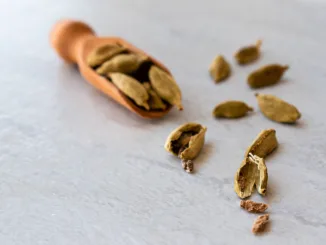

New York-based tea company Dona takes a trip to Nicaragua, where they learn more about cultivating spices like turmeric, ginger, and cardamom.
BY NAVDEEP KAUR
FOR BARISTA MAGAZINE
Photos by Amy Rothstein
What to know:
- Brooklyn-based tea company Dona took a trip to Nicaragua to visit its sourcing partner Doselva, an organic spice producer working with over 500 smallholder farmers to grow turmeric, ginger, cardamom, and other crops through equitable contracts and traceable supply chains
- Doselva promotes regenerative agroforestry and climate-resilient farming by integrating spices with crops like coffee, cacao, bananas, and citrus under layered forest systems; the company also aims to expand Nicaragua’s cardamom industry by distributing tens of thousands of saplings to local farmers
- Farmers in regions like Rio Blanco and Ubunorte are diversifying away from cattle farming into spice production, which has created new income opportunities, supported reforestation projects, and helped communities adapt economically and environmentally to climate change
Where you most often follow sourcing trips in the context of coffee in Barista Magazine, the team from Dona, the Brooklyn, N.Y.–based tea company, recently took a trip to Nicaragua to do a different kind of sourcing: We sought turmeric, ginger, and cardamom, crucial ingredients for our concentrates and other products. Like the best specialty-coffee buyers, we prioritize cultivating relationships with small-scale farmers.
On this venture, we would accompany our partner, Doselva, a producer, processor, and exporter of 100% organic turmeric, ginger, cardamom, allspice, vanilla, and lemongrass. With operations in Honduras and Nicaragua, Doselva works to bridge the gap between smallholder farmers and the marketplace by providing resources and financing and ensuring income through contract growing. Their current smallholder farmer network is 500 and growing each year. Working with Doselva, which we’ve been fortunate to do for two years, has allowed us to prioritize traceability and quality.
Jefferson Shriver, co-founder and owner of Doselva, invited the Dona team to visit Nicaragua to strengthen our relationship, meet their partner farmers, and look at Doselva’s spice-drying facility in Granada, Nicaragua. Jefferson planned the trip, provided guidance and hospitality, and drove the Dona team through the rugged terrain of rural Nicaragua to make a meeting with partner farmers possible.
In fact, Jefferson started out as a coffee producer in Nicaragua. He decided to diversify into vanilla and subsequently expanded to turmeric, ginger, and cardamom when income from coffee became unreliable. With a background in social entrepreneurship and regenerative agriculture, he specializes in climate-focused agriculture that utilizes agroforestry systems. This ethos is the driving force behind Doselva and, ultimately, what drew us to this partnership.

Day 1: Arrival in Granada, Nicaragua
After a long day of travel and a mid-afternoon arrival, we went directly to Gaia Forest Café, which Jefferson owns and operates as a launching pad for his harvests. The café integrates crops from Doselva’s farm in Diriamba, including single-origin coffee and shots made from freshly harvested turmeric and ginger. After a hearty and delicious lunch, Jefferson invited us to his home that evening for drinks and snacks.
Our first day in Nicaragua concluded over cheese, crackers, a hibiscus cooler, and lively conversation. We discussed Jefferson’s work in Nicaragua, the history and challenges that Doselva currently faces, and chatted about plans for the next day before we fell into our beds.
Day 2: Doselva’s Farm and Gaia Forest, Diriamba
The day started off rainy, but Jefferson had us covered with loaner raincoats and boots. We pulled our gear on as Jefferson showed us a map of Nicaragua, pointing out Doselva’s reach and the regions where farmers grow turmeric, ginger, and cardamom.
In the interest of time, we planned to visit farms in the low mountainous region of Diriamba and Rio Blanco. After an hour’s drive, we arrived at Doselva’s five-acre farm, which borders Jefferson’s own 10-acre farm, Gaia Forest.
We were welcomed with freshly brewed coffee that had been grown on the farm before Jefferson started our tour. These farms work as starting points for farms in the Doselva network.

At Gaia Forest, seeds are propagated and saplings are grown and stored safely to ultimately be shared with partner farmers. The yield from the two farms accounts for 2% of Doselva’s crops.
The rain kept pouring, and the sky felt heavy above us with thick, gray clouds. We walked along the muddy trails, past coffee and spices, as Jefferson told us about the farms’ agroforestry, sustainability, and crop diversity programs.
Agroforestry is central to the values of Doselva and operations on the farm, which have been structured to mimic a forest with the four levels of an ecosystem. In the first layer, leaf residue covers the soil, provides nutrients, and protects the ground below.
The second layer grows cash crops such as coffee, cardamom, ginger, and turmeric. In the third layer, banana, avocado, cacao, and citrus trees provide shade, and the final layer comprises woodier and more robust trees to protect everything below.
Along the path, we saw cardamom saplings waiting to be distributed to farmers and transplanted on their land. Cardamom plants get tall and flower throughout the year, but are selectively harvested year-round from each seed.
We picked the bright-green, juicy, ripe pods, then opened them to taste the sweet, intense, menthol-like seeds inside. Jefferson explained that his hope is for Doselva and Nicaragua in general to become the next hub of cardamom production. As part of that effort, Dolselva intends to distribute between 30,000 and 50,000 cardamom saplings to nearby farms to get the industry going.
With the rain finally letting up, we stopped to observe a sample harvesting of turmeric root. Leonardo Mendieta, a farmer at Doselva, took his shovel, dug it into the ground near the base of the green leafy stalk, and pulled out a dirt-covered root with vibrant orange turmeric fingers peeking out.
The earthy, warm spice of the root lingered in the air as we took turns smelling it. After breaking it up and cleaning it, Leonardo dropped the turmeric in a bucket, and we continued on. I held the turmeric leaf in my hand so the fragrance would faintly linger with me for the rest of the trail.

Day 3: Doselva Facility and Rio Blanco
After a filling breakfast of eggs and beans, we headed over to Doselva’s processing plant. Once there, we sat for introductions with the Doselva staff. They each shared why they liked working at Doselva and how it is a resilient, dynamic company that provides alternatives for farmers, promotes a family-like environment, and exposes them to a cooperative business structure.
Doselva helps by diversifying crops as well as incomes, and empowers farmers to be strong in the face of climate change. The Dona team shared about tea-concentrate production and why it’s important for us as a company to source equitably.
Next, the Doselva crew toured us through the processing facility. We started in the receiving area, where cardamom arrives by the sack, and ginger and turmeric containers from different farmers are sorted by color. We spoke with the head of traceability, who oversees the arrival of two or three trucks of produce each day. He explained how he assesses quality, monitors potential contamination points, checks documents and lots, and sorts the products between organic and conventional.
We joined the Doselva team in sorting cardamom by hand and learned how it’s done from the women on the line. Afterward, we moved on to the ginger and turmeric washing station.
The staff members slice through about 650 kilograms of root vegetables per day. Products are air-dried 40% of the way at 30–65° Celsius (86-149° Fahrenheit) for 24–48 hours. They are then weighed in order to calculate the loss of moisture, after which they are transferred to the oven to finish drying to between 10% and 12%.
Finally, the ginger and turmeric are graded and milled according to customer specifications. After taking a tour of all the operations in the facility, we got to taste some freshly dried ginger, turmeric, and cardamom with the Doselva crew.

After the tour, we set out on the four-hour drive to Rio Blanco with Jefferson. When we were about halfway, close to the town of Boaco, we were joined by Reynaldo Miranda, one of Doselva’s farm technicians, who has on-the-ground knowledge of the farmers and their individual farming practices,
and has skills to work with turmeric, ginger, and cardamom.
At dinner in Rio Blanco, we learned more about the farmers we would visit the next day. Growers located in the area between Rio Blanco and Ubunorte had until recently relied exclusively on cattle farming for cash and were trying to diversify by growing turmeric, ginger, and cardamom. In fact, farms in these areas receive a decent amount of rainfall and are rich in organic matter, which is ideal for growing ginger and turmeric. Farmers fertilize their plants with manure from their cattle and have been pleased thus far with the additional income they’ve been able to generate.
Day 4: Meeting Farmers in Ubunorte
The road to Ubunorte was a rough one. Jefferson deftly steered his truck through streams and alongside steep slopes. As we drove up to the farm gates at our first stop, the owner, Valentín Obando, was waiting to greet us.
Walking us through his farm, he showed us the patches of land where he grows organic-certified turmeric and cardamom for Doselva. A little less than a hectare of his land is dedicated to Doselva. The rest is for the family’s cattle, and for subsistence he grows beans, maize and yucca. We also saw his newly planted cardamom under the shade of banana trees.

Next, we visited farms belonging to a man named Rito Julio Martines Ochoa and his son Moisés Axalon Martines Moreno. For two years, they’ve been growing turmeric and ginger with Doselva and have seen a significant increase in their turmeric yield.
Their turmeric is planted over three hectares and yields about 1,000 sacks, which generates almost $15,000 USD in gross income. They also grow sugarcane, maize, and yuca for sustenance and to sell in local markets.
In addition to working with Doselva, Rito and Moises participate in a reforestation project that requires farmers to plant saplings in under-utilized parts of their farms in exchange for direct payments over time, as the trees help cut carbon from the atmosphere. The men showed us their nursery and the area of the farm dedicated to the reforesting initiative.
Having grown up in the area, Rito bought his farm 35 years ago. He sells corn and beans in the Ubunorte municipal markets and uses cattle for milk. Rito had some prior turmeric-growing experience, having worked with a similar cooperative seven years ago. Rito hopes that growing ginger and cardamom for Doselva will bring him the same success. Reflecting on the future of his farm, he told us that he wants to gather resources and continue to work on the farm in an effort to establish more grasslands for cattle. On the other hand, Moises hopes the ginger and turmeric production will eventually surpass the revenue the cattle brings in for their family.
Rito told us that he prides himself on sharing his success growing turmeric with other nearby farmers like Valentín because the region is becoming known for the crop.
Our last stop for the day was at a farm owned by a woman named Kenia Yamileth Paz Duarte. Her little girls and neighbors welcomed us and she fed us chicken soup, steamed vegetables, rice, and tortillas. Kenia currently only grows turmeric, but Doselva is hoping to get her on board to add ginger and cardamom. After the hearty meal, we set out for the long drive back to Granada with Jefferson.
Day 5: Final Day
We reconvened the next morning at Gaia Forest Café for a last round of delicious turmeric shots, over which we thanked Jefferson for the incredible trip. We also discussed our vision for the future of Dona and Doselva’s partnership. While this trip consisted of visiting farmers who grow a combination of turmeric, ginger, and cardamom, Jefferson said he hopes to take us to the more remote regions of Nicaragua, where farmers grow turmeric and ginger exclusively, on our next sourcing trip.
Our trip gave us invaluable insights into the practices, challenges, and opportunities surrounding the production of turmeric, ginger, and cardamom crops. By observing firsthand how local farmers cultivate and produce their goods, it’s clear that equitable partnerships are essential for creating a sustainable and just supply chain.
This reaffirmed the importance of building and maintaining a long-term relationship with Doselva so that we at Dona can continue to procure high-quality spices grown in harmony with nature and the people inhabiting it.
This article originally appeared in the February + March 2025 issue of Barista Magazine. Read more of the issue online here for free.
ABOUT THE AUTHOR
Navdeep Kaur (she/her) heads research and development and tea education at Dona in Brooklyn, N.Y. She was born and raised in New Delhi, India. Her interest in teas started at a young age and bloomed
when she moved stateside to attend New York University for a master’s program in food studies and sociology.

Subscribe and More!
As always, you can get a hard copy of Barista Magazine by subscribing or ordering an issue.
Support Barista Magazine and show your love with a Membership.
Signup for our weekly newsletter.
Join us at Camp Coffee Shop Aug. 10-13 in Napa, California.
Read the April + May 2026 21st Anniversary Issue for free with our digital edition.
For free access to more than six years’ worth of issues, visit our digital edition archives here.