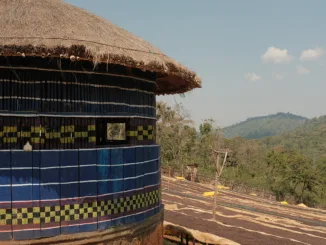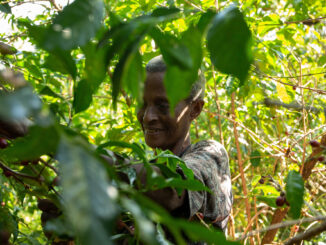

In Ethiopia, coffee is as much a ritual as it is a beverage.
BY BHAVI PATEL
BARISTA MAGAZINE ONLINE
Featured photo by Yosef Futsum. All other photos courtesy of Bhavi Patel.
The invitation is rarely a formal summons; it is more of a gravitational pull. In Addis Ababa, a neighbor stops by or a guest crosses the threshold, and suddenly, the clock stops ticking and starts breathing. I have learned the hard way that you don’t “grab” a coffee in Ethiopia. You bow down to it.
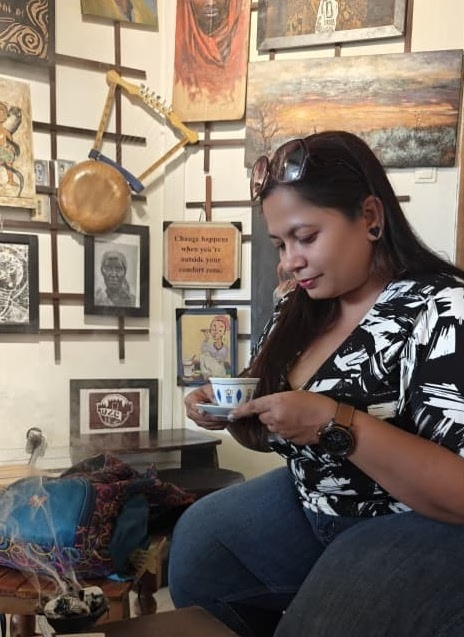
I sat on a low stool as my host crouched over a small flame—or an electric stove, because even ancient rituals eventually make peace with the power grid. She swirled raw green coffee beans in a flat iron pan with the nonchalance of a conductor. Slowly, the beans began to crack and weep oil, releasing a smoke so fragrant it felt less like an aroma and more like the air itself was being seasoned. Before a single drop was poured, she carried the pan to me. I leaned in, inhaling the ghost of the brew to come. It’s an offering of intent: This is what we are building together.
Then came the mortar and pestle. No burr grinders, no digital scales, no frantic whirring of blades. Just the rhythmic, meditative strike of metal on stone. In a world obsessed with “workflow efficiency,” the deliberate manual labor of the crush felt like a quiet act of domestic rebellion.
The Physics of the Clay
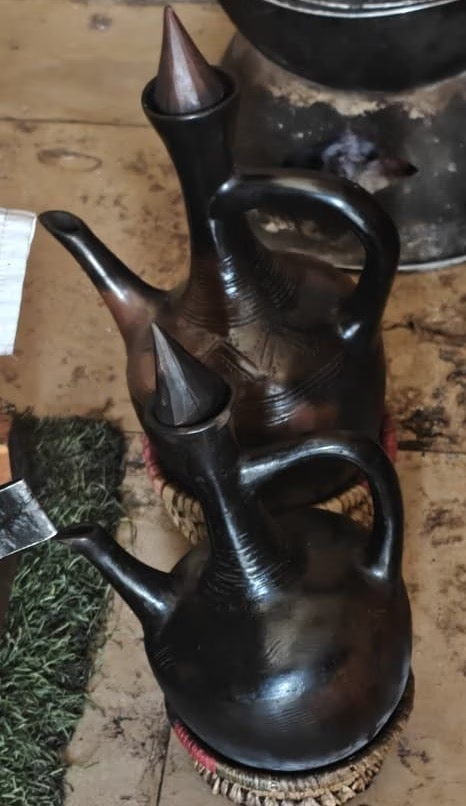
The vessel for this alchemy is the jebena, a round-bottomed, long-necked clay pot that looks like it was birthed by the earth rather than a factory. And essentially, it was. Hand-shaped by women potters and fired in open kilns, the jebena is a masterclass in organic engineering.
Its design is a triumph of elegant physics:
- The Spherical Base: Allows heat to circulate with a convective consistency that would make a laboratory chemist jealous.
- The Long Neck: Acts as a natural cooling tower and sediment trap.
- The Filter: Usually just a bundle of grass or horsehair wedged into the spout.
There is no paper filter to strip away the soul of the bean. The jebena produces a cup that is remarkably clear yet retains every ounce of its essential oils. It is “hospitality architecture”—a physical object designed to slow time down until it matches the pace of a conversation.
The Three-Act Play
In an Ethiopian home, coffee is not a caffeine delivery system; it is a three-act play. You don’t just drink; you participate in a sequence known as Abol, Tona, and Baraka.
- Abol: The first and most potent pour. This is for the heavy lifting of news and greetings.
- Tona: The second round, slightly lighter, where the conversation begins to mellow and meander.
- Baraka: The “blessing.” The final, lightest cup.
To leave before the Baraka is not just a breach of etiquette; it is a refusal of the blessing itself. To sit for two hours over three rounds is to acknowledge a fundamental truth: you matter enough to warrant my fire, my finest beans, and my undivided attention. It is the antithesis of the “to-go” cup.
The Verdict on the Palate
So, what does it actually taste like? Forget the sterile, tea-like clarity of a $9 pour-over in a minimalist café.
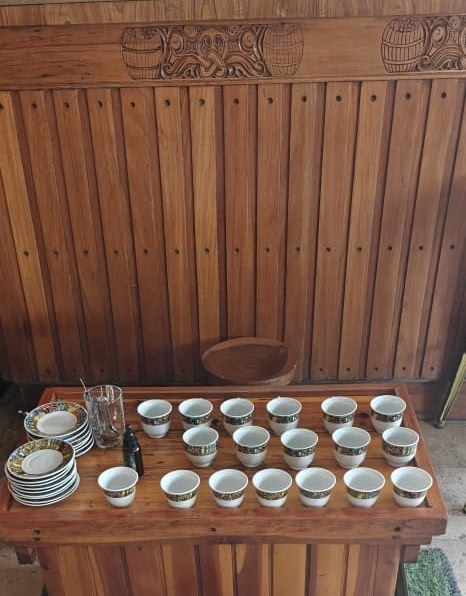
Because of the lack of paper filtration, the body is velvety—almost syrupy. The flavor profile is a startling contradiction: bright, floral heirloom Arabica notes colliding with the chocolate and woodsmoke of a ceremonial dark roast. It is served in small, handle-less cups, often with enough sugar to make your teeth ache (or a sugar pot on the side so you can add as much as you please), and occasionally a sprig of rue for an herbal kick.
It is intensely, irreducibly itself. You cannot replicate this in a commercial kitchen anywhere in the world. You would be missing the smoke, the clay, and the specific weight of the Ethiopian air.
Ultimately, the Jebena teaches you that coffee isn’t a beverage. It is a philosophy served in three rounds. It is an hourly reminder that the most productive thing you can do is absolutely nothing at all, provided you are doing it with someone else.
ABOUT THE AUTHOR
Bhavi Patel is a food writer focusing on coffee and tea, and a brand-building specialist with a background in dairy technology and an interest in culinary history and sensory perception of food.

Subscribe and More!
As always, you can read Barista Magazine in paper by subscribing or ordering an issue.
Support Barista Magazine with a Membership.
Signup for our weekly newsletter.
Read the February + March 2026 Issue for free with our digital edition.
For free access to more than five years’ worth of issues, visit our digital edition archives here.