
Inside the women-led coffee movement in Rwanda that’s transforming menstrual health from a hidden barrier into a foundation for empowerment.
BY CAROLINE CORMIER
FOR BARISTA MAGAZINE
Photos courtesy of Elevate Through Coffee
On Rwanda’s steep, green slopes, families rise before dawn to tend to the coffee trees that power a $116 million export industry. But a closer look at the data reveals something striking: Women are the true force behind Rwanda’s coffee. According to a 2025 report by the International Institute for Sustainable Development, 57% of Rwanda’s coffee growers are women, and nearly 70% of the labor—from farm to cup—is done by their hands.
Yet few women own the land they cultivate or hold leadership roles in cooperatives. While landmark reforms have advanced women’s rights in Rwanda, such as the 1999 Inheritance Law and the 2013 Land Law, and more than 60% of land titles are now registered to or co-owned by women, systemic barriers persist. As the International Coffee Organization noted in its 2018 report, “Gender Equality in the Coffee Sector,” women across global coffee value chains still face unequal access to credit, farm inputs, and decision-making power. Rwanda is no exception; many of these barriers still persist in the country.
These inequalities extend beyond ownership or wages. They shape how women live and work each day. In many coffee-growing communities, for instance, limited access to menstrual products, sanitation facilities, and education continues to affect women’s ability to participate fully in daily farm work and cooperative life.
The Hidden Costs of Inaccessible Menstrual Care
Despite Rwanda’s impressive progress in gender equality, including the government’s 2020 removal of the value-added tax on sanitary products, the cost and accessibility of menstrual supplies remain prohibitive for many rural women. Recent studies by the United Nations Population Fund (UNFPA) and United Nations Children’s Fund (UNICEF) indicate that up to 15% of Rwandan school girls still miss classes each month due to menstruation, and nearly a quarter of women in the country reported missing work or income-generating activities because they lacked access to menstrual pads.
In many coffee-farming communities, a day’s earnings barely cover the cost of a single pack of sanitary pads, and even where women can afford them, access remains limited due to scarce rural supply chains. The result is predictable: Menstruation can mean losing crucial labor days during harvest season. This is not a marginal issue but a central development concern tied directly to the sustainability of coffee-growing communities. When women lack reliable menstrual care, girls drop out of school, women miss income-generating work, and participation in local leadership declines.

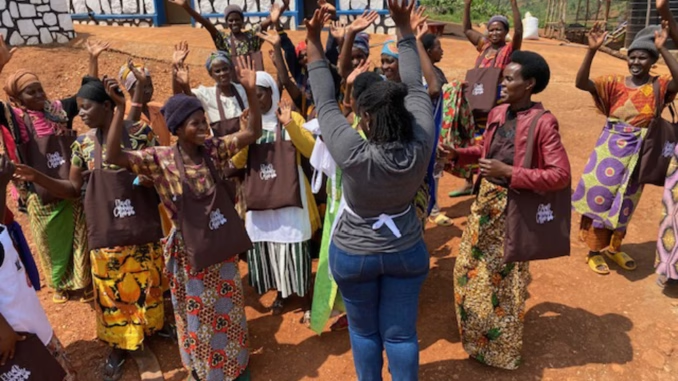
Through her program, Elevate Through Coffee, designed to empower and support coffee farmers, especially women, Smayah has organized multiple distributions of hygiene kits and sanitary products to women growers across Rwanda. Here, she is seen with bags of those products just before giving them to women in a rural coffee community.
Women-Led Solutions
Grassroots women’s cooperatives are reshaping the future of Rwanda’s coffee economy. Among them, Rambagira Kawa stands out as a model of women’s leadership and community transformation. As the women-only wing of the Dukundwe Kawa Musasa cooperative in Gakenke District, Rambagira Kawa channels earnings from its “women-grown” coffees into projects that strengthen the social fabric: livestock programs, education initiatives, and menstrual health campaigns.
“We stand up for ourselves and work hard to feed our families, with or without a man to support us,” said Odette Murekatete, president of Rambagira Kawa, in an interview with the International Climate Initiative. Their motto captures their spirit perfectly: “Strong Women, Strong Coffee.”
Research published in 2025 by the International Institute for Sustainable Development shows that when women’s coffee associations control cooperative premiums, they often invest in social infrastructure that directly benefits women and girls. The Rambagira Kawa Women’s Association, for example, used part of its earnings to distribute thousands of hand-sewn reusable pads to schoolgirls who had dropped out due to lack of access to sanitary products. This single initiative enabled many girls to return to school.
The lesson is simple but transformative: Menstrual health is central to women’s dignity, productivity, and full participation in Rwanda’s coffee economy. When women have reliable menstrual care, they can remain engaged in farming, send their daughters to school consistently, and participate in cooperative leadership. These grassroots investments reveal a new model for inclusive development—one where coffee becomes a vehicle for social change in rural communities.
Another example comes from Smayah Uwajeneza, a leading Rwandan coffee professional and award-winning barista and roaster known for her expertise in sustainability, training, and community building within the coffee industry. In 2019, she launched Elevate Through Coffee with the goal of uplifting Rwanda’s coffee industry by championing specialty coffee, strengthening quality standards, and supporting farmers—especially women. For Smayah, coffee is more than a commodity; it’s a catalyst for compassion and collective change.
“Coffee has always been a story of resilience, and women are at the heart of that story,” she says. “My own journey in coffee taught me that transformation often begins with the smallest acts of compassion. Elevate Through Coffee was born from a desire to turn those acts into collective action, ensuring that farm families have access to the opportunities, education, and dignity they deserve.”

One of Elevate’s defining commitments is addressing challenges that often go unseen. Smayah first encountered the barrier of inaccessible menstrual products while working directly with women coffee farmers. She noticed that some women would miss training or harvest sessions without explanation.
“When I asked why, their friends told me they were on their periods and didn’t have access to sanitary products,” she says. “That moment broke my heart. I knew that if they missed a day of work, they also missed a day’s wage, which could mean no lunch or dinner for their families. That’s when I decided to act.”
For Smayah, this wasn’t charity; it was reciprocity. “These women are the reason I have a career and impact, and the least I can do is make sure their work, their dignity, and their livelihoods are never interrupted again, within my capacity,” she says.
Since then, Elevate Through Coffee has organized multiple distributions of hygiene kits and sanitary products to women growers across Rwanda. But for Smayah, the act of giving goes far beyond the supplies themselves.
“What I saw during those distributions were tight hugs and words of gratitude from women who never imagined anyone would care about such a personal challenge,” Smayah says. “Menstruation is still something rarely talked about in our communities, so for them, this gesture meant being seen and valued.”
She remembers one woman’s words in particular: “Sinumvaga ko hari uwadutekerezaho kururwego, ariko Imana izabikwishure,” which translates to, “I never thought anyone would care this much, but only God can reward you for it.”
Women began to approach Smayah after the distributions, asking whether similar support could reach their daughters. “Many women told me they hoped we could extend the support to their daughters in school,” she adds, “and that’s exactly what we’re working toward.”
While these efforts have brought tangible relief, Smayah’s vision extends beyond immediate aid. She emphasizes that true empowerment lies in sustainability, building a future where women no longer depend on donations but on their own thriving livelihoods.
“My hope is that while we begin by distributing sanitary supplies, our long-term vision is to help women build community-led businesses, especially during the off-season—ventures that can generate extra income and allow them to afford these essentials themselves,” says Smayah. “When women can work comfortably and consistently, they’re able to earn, save, and reinvest in their families and farms, creating a ripple effect of stability and growth.”
For Smayah, the connection between quality coffee and human dignity is inseparable. “Elevating women in this way doesn’t just improve livelihoods. It strengthens the entire coffee value chain and reminds us that sustainability isn’t only about the environment,” she says. “It’s also about people. And there’s no sustainable coffee without a sustainable community.”
The Road Ahead
The work of women’s cooperative associations and initiatives like Elevate Through Coffee proves that solutions are possible and can be embedded directly into the value chain. But progress remains uneven. Menstrual products remain prohibitively expensive for many households. Sanitation infrastructure in rural schools and cooperatives is still inadequate, offering little privacy or hygiene. Cultural stigma continues to silence open discussion of menstruation. Meanwhile, climate change and volatile coffee prices add pressure to already fragile household economies, limiting the ability of cooperatives to consistently fund social projects.
Sustained efforts are needed—scaling up local production of affordable reusable pads, integrating menstrual health into cooperative training, expanding policy support, and maintaining strong grassroots advocacy. The integration of menstrual health into Rwanda’s coffee sector reveals a broader truth: Agricultural value chains can be vehicles for social transformation. Women-led projects have boosted women’s leadership, created visibility for women’s coffees in international markets, and reinvested premiums into education and health care. These efforts prove that centering women in development produces economic, social, and generational ripple effects.
When we sit down to enjoy a cup of Rwandan coffee in Paris, New York, or London, we are participating, however indirectly, in a system that can either perpetuate hidden inequities or help dismantle them. Linking consumer awareness, cooperative investment, and access to menstrual health ensures that gender equity in coffee is not only symbolic but also substantive. Supporting women farmers means supporting their full dignity, including the right to manage menstruation without shame or deprivation.
Menstrual health may seem like only a small detail in the wide expanse of global agriculture. But as Rwanda’s women coffee farmers and advocacy efforts like Elevate Through Coffee remind us, sometimes the smallest details determine whether progress is sustainable, equitable, and just.
This article originally appeared in the December 2025 + January 2026 issue of Barista Magazine. Read more of the issue online here for free.
ABOUT THE AUTHOR
Caroline Cormier, Ph.D. (she/her), is a writer from Canada who is now based in Berlin. Always looking for new ways to combine her passion for research and storytelling with her love of coffee, Caroline has been contributing to Barista Magazine since 2018. Her writing primarily focuses on spotlighting community stories, top coffee destinations, product and design innovations, and critical issues such as sustainability and social impact.

Subscribe and More!
As always, you can read Barista Magazine in paper by subscribing or ordering an issue.
Support Barista Magazine with a Membership.
Signup for our weekly newsletter.
Read the December 2025 + January 2026 Issue for free with our digital edition.
For free access to more than five years’ worth of issues, visit our digital edition archives here.