A look at Mexico City’s blossoming specialty-coffee scene + 4 noteworthy cafés leading the movement.
BY JEN ROBERTS
FOR BARISTA MAGAZINE
Photos by Jen Roberts unless otherwise noted
From the street, Laguna is understated. Its exterior resembles any other industrial building in the Doctores neighborhood of Mexico City: utilitarian, muted, with large windows and little to distinguish it from the surrounding block. Back in 2021, there was no sign marking the space, so when I buzzed the black button near the door, I wasn’t entirely sure I was in the right place.
I explained to the person at the entrance that I had an interview with Alberto Riviera-Torres, partner and CEO of Buna, and was welcomed into the space. Inside, this former lace and thread factory opens to a central courtyard filled with plants and yellow and green metal tables and benches that keep with the building’s industrial past.
Metal window frames and stairwells painted in an olive green softened the gray concrete, while design studios and other creative businesses lined the perimeter. On that first visit, Laguna housed Buna’s roastery, though its café in this space would open the following week. Over the last five years, I’ve watched Laguna evolve into a hub for design, gastronomy, art, and community. Today, an architecture bookstore, a natural wine shop, and a small independent press, among many other businesses, occupy the space, while Buna continues to expand, creating cozy nooks where people can settle in over a cup of coffee.
A city of contrasts
That kind of hidden transformation feels distinctly Mexico City.
It’s a city to get lost in. The streets of Centro Histórico, where my former apartment was located, pulse with intensity. It’s easy to get swept up with the people, walking with purpose, but then you miss the open kitchens at taquerias like Los Cocuyos that invite you to grab a taco or two on the go, or the organilleros in their khaki uniforms, hand-cranking barrel organs to create an airy organ melody that is ubiquitous in the city.
If you allow yourself to break the fast pace of the average pedestrian, you’ll find hidden markets, former churches that have been a transformed into libraries, tiny independent theaters tucked inside nondescript buildings, celebrated murals, and architecture that dates back centuries.
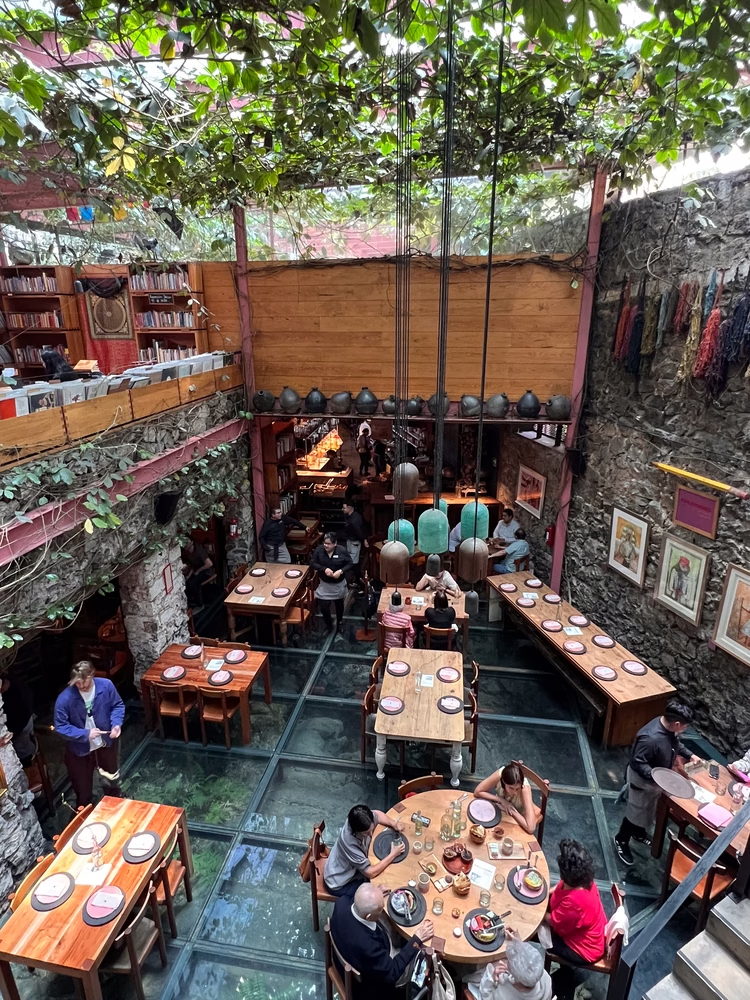
The contrast found in Centro repeats itself across the city. Mexico City is made up of nearly 2,000 colonias, each with its own distinct rhythm.
From Xochimilco’s waterways and floating farms to Polanco’s polished storefronts, it’s a city of a thousand cities. Santa Fe rises vertically, while Coyoacán’s stone streets and hidden colorful courtyards feel rooted in another time. Jardines del Pedregal, an affluent neighborhood in the south, was developed by Luis Barragán on volcanic lava fields, while Del Valle feels residential with its mid-century homes and tree-lined streets.
Yet despite how dramatically the city shifts from one neighborhood to the next, certain threads remain constant: taquerias, mercados, torta trucks, and cafés. Woven together, they form the city’s daily fabric. No matter where you are, you’re never far from the sweet, smoky flavor of an al pastor taco, topped with a spoonful of picante and a squirt of lime, or from a good cup of coffee waiting just around the corner.
The coffee boom
Coffee, like so much in Mexico City, carries a connection to the land and an artful approach. The city’s coffee culture is inseparable from Mexico’s growing regions, particularly Oaxaca, Chiapas, Veracruz, and Puebla, where much of the country’s coffee is cultivated by smallholder producers. Mexican coffee is known for its bright acidity, delicate sweetness, and notes of chocolate and fruit.
In the capital, that agricultural tradition has evolved into one of the most dynamic urban coffee scenes. Passmar, widely recognized as one of the city’s first specialty-coffee shops, helped introduce a new vocabulary, one that focused on origin, roast profile, extraction, and traceability, at a time when specialty coffee was still unfamiliar to many drinkers.
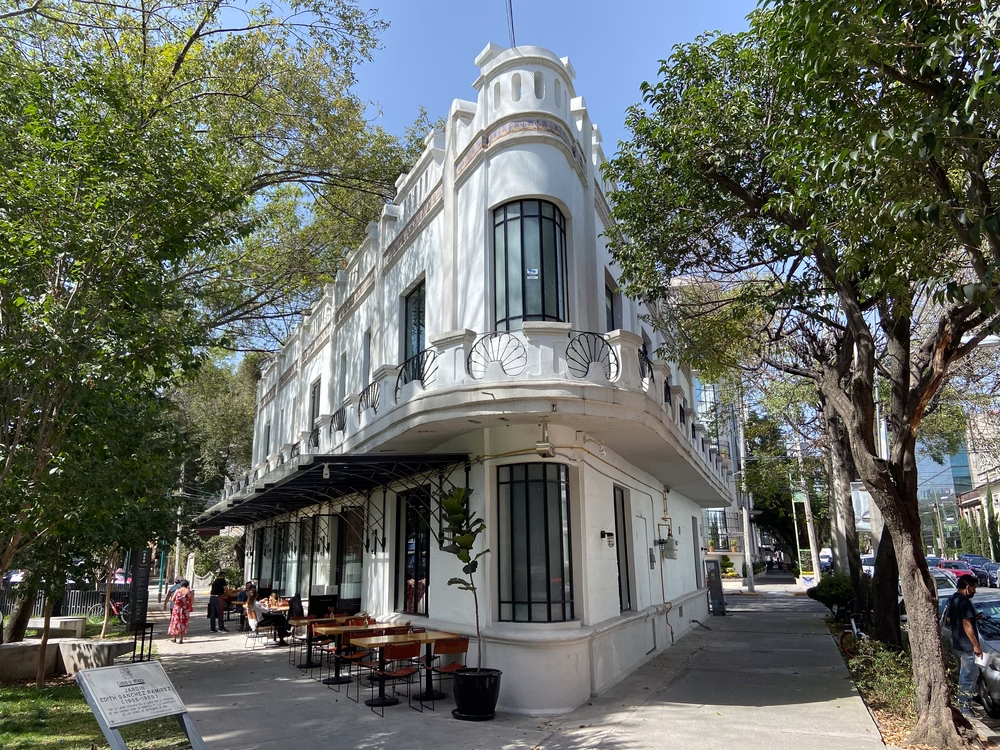
The diversity that defines coffee production across Mexico is reflected in the capital, where the café scene has expanded so quickly that it’s hard to keep pace. Alberto of Buna shared that more than 600 new coffee shops opened in the city between 2021 and 2025. The highest concentration is in the borough Cuauhtémoc, where there are roughly 47 cafés per square kilometer.
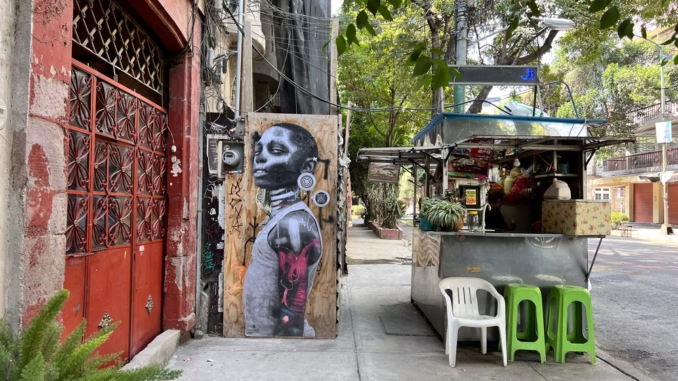
A short walk through Cuauhtémoc reveals cafés pushing the boundaries of what a coffee shop can be. On a busy corner in Roma Norte, Tormenta serves specialty drinks from a silver stand more commonly associated with tacos and tortas. Stickers cover the stalls’ walls, while small stools on the sidewalk serve a constant rotation of customers, creating a casual street energy. In Juárez, El Minutito leans retro with mirrored walls, vintage details, and an Italian-style standing espresso bar that recalls old Mexican cantinas.
What began as a niche movement has become part of everyday urban life. The rise reflects demand, but also a growing fluency among drinkers. There is no single way to define Mexico City’s coffee scene, but both longstanding cafés and newcomers must pair craft with originality to stand out in an increasingly saturated market.
Café Avellaneda
Carlos de la Torre grew up playing ping pong and drinking espresso at his uncle’s restaurant in his hometown, Acolman, located in the State of Mexico. He later moved to Mexico City to study philosophy. “As any college guy studying philosophy, I drank a lot of coffee,” he laughs.
Helping at his uncle’s restaurant made him realize that he not only had a passion for coffee, but also for serving people. He opened a tiny coffee shop in his hometown, but “no one drinks coffee there,” he says, so he tried again after returning to the city.
When he opened Café Avellaneda in Coyoacán in 2009, it was one of the city’s first specialty-coffee shops, though Carlos acknowledges that there was already a small scene of people doing specialty coffee. “I got lucky to kind of be adopted by them. I visited every coffee shop, and they showed me how to roast, they gave me my first cups, they taught me about competitions. It was a beautiful, small community.”
He noticed a major shift in the number of cafés in the city in 2015 and says customers became more knowledgeable. “They came in asking if we have natural Geshas,” he says.

Café Avellaneda sources from Chiapas, Oaxaca, and Veracruz, with occasional coffees from Puebla, Hidalgo, and Guerrero. They also make their own oat milk, an idea that came to Carlos after he was inspired by a coffee served with homemade macadamia milk at Go Get Em Tiger in Los Angeles. When he came back to Mexico, he began experimenting and then scaled it. “It’s amazing. It’s natural and cheaper,” he shares.
Carlos began roasting in 2012 after unexpectedly winning the Mexican Cup Tasters Championship. (He went on to win the Mexican Brewers Cup in 2015 and 2016, the Mexican Barista Championship in 2018 and 2019, and then the Coffee Masters Championship in 2019, but that’s another story.) “I am not a top taster. I went to the cup tasting championship because my cousin wanted to try it and didn’t want to go alone,” he says.
He began roasting in preparation for the world competition, and when he served those coffees in the café, people responded favorably. What has sustained Café Avellaneda, and will likely mean the success of his new project, Ciottolo, is Carlos’ belief that craft and community belong together. “Every morning I come at 7:30 to dial in the espresso to make sure the coffee tastes how I want it to taste,” he says. It’s that dedication to craft in a welcoming space where conversations happen naturally at the bar that keeps people returning.
Chiquitito Café
When I began regularly visiting Mexico City in 2018, I started nearly every morning at Chiquitito Café with a cortado at an outdoor table, where I’d spend the first hours of the day people-watching. Jeremy Clouser and Cecilia Morales opened the original café in a tiny Condesa space in 2012. Hence the name: Chiquitito. By the time I discovered it, the café had already become a neighborhood fixture.
As one of the city’s first specialty-coffee shops, opening didn’t carry the same pressure it does today. Customers were still learning what specialty coffee means, which allowed them to grow slowly and learn every part of the business themselves. “We did everything—Instagram, the bakery, we worked all day on Sundays so our team could rest,” shares Cecilia. “It was a great experience because we were able to learn every position in the café.”

They knew they wanted to provide great coffee in a well-designed space, but just as important was building a culture around coffee through developing relationships with Mexican producers. Today, they have continued relationships with Fincas Las Nieves in Oaxaca, and Finca Peccora and Lidia Fuentes in Veracruz. “I think that’s one of the unique things about Mexico, is that in two hours you can be on a coffee farm,” says Jeremy.
That Chiquitito has remained a fixture in the Mexico City coffee scene and has added new cafés in the Condesa, Chapultepec, and Lomas neighborhoods speaks to the dedication of Jeremy and Cecilia, who are very present in their cafés. They want to serve great coffee, but it goes beyond that. “This project was so much bigger than just serving coffee. It was making a neighborhood, a community, creating connections like this, the laughter and conversations,” explains Cecilia. “We want a space where our kids could come with us and feel comfortable, and for the people who work for us to have a good experience. It’s the experience that people remember.”
Buna
What began with a small sample roaster by a group of high school friends in a family attic has grown into one of Mexico City’s most established specialty-coffee companies, one rooted equally in craft and environmental commitment. Since opening in 2012, Buna’s core focus has remained the same. “We roast our own beans, work directly with producers. Our relationship with agriculture has changed over the years, but our commitment has not changed. We’re still here to converse ecosystems through sharing coffee, cacao, and honey,” says Alberto.
That commitment takes shape through close relationships with small producers who are not working with larger cooperatives. Buna serves as a specialty market for their coffee. “We try to help them get the resources to have the necessary infrastructure to go from a certain point of quality to a much higher one,” Alberto explains.
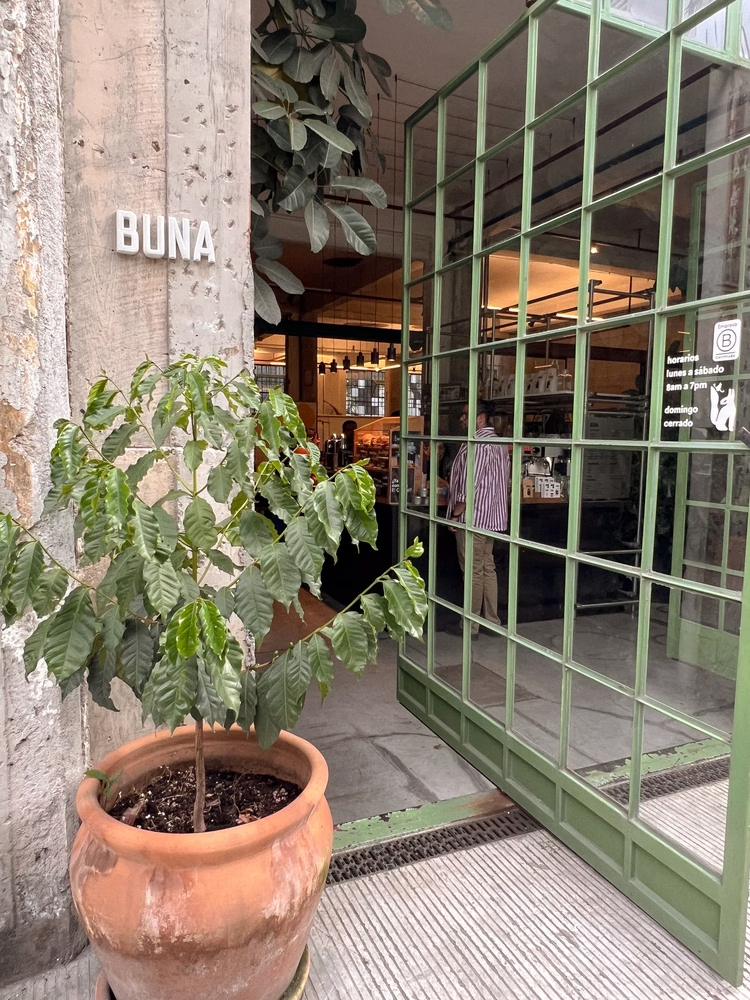
To support that work, Buna has partnered with El Buen Socio, a local financial institution that backs projects with social or environmental impact in rural Mexico by providing financial support. El Buen Socio requires assurance that producers have a buyer, and Buna provides that stability.
By the time specialty coffee began to expand rapidly across the city, Buna was already well established. “The thing that we appreciate from competition is that it’s continuing to push us to have a great experience at the bar and (to maintain) the quality of our coffees,” Alberto says. That focus has allowed Buna to expand; they now have cafés in Roma Norte, Condesa, and a newly opened shop in Polanco. Across neighborhoods, the quality remains consistent, allowing the Buna team to deepen producer relationships while continuing to grow.
La Valiente
When the doors to La Valiente opened in September of 2025, Valeria Lazcano entered a coffee scene far more crowded than the one that welcomed the city’s earliest specialty cafés. Customers already understood origin, roast profiles, and brewing methods, so opening a new café meant offering something distinct enough to make customers return.
And Valeria did just that. The space she created is colorful, playful, and inviting. Inside, the yellow counter tiles continue whimsically onto the floor, while exposed brick arches bring warmth to the space. The café’s name stretches across the front of the building in illuminated boxes, each letter glowing red inside its own white frame. On the front window, bold red letters read: Hoy tu eres valiente: Today you are brave.
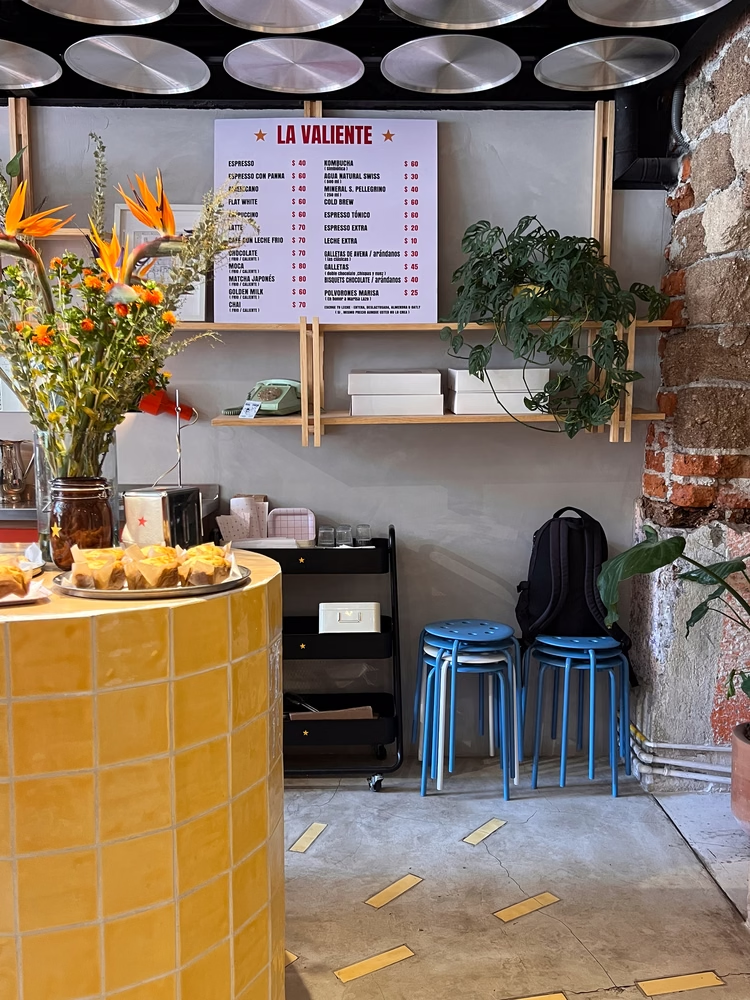
Rows of circular overhead lights draw you inside, where every detail has been carefully considered. A star logo is used throughout the café, inspired by the stickers once given to children across Mexico as a reward. The idea came after Valeria found a childhood photo of herself with pigtails, a big smile, and a metallic star sticker pressed to her forehead.
The star carries no fixed symbolism but seems to say: I see you, and you’re doing good. “People actually started putting the stickers on themselves,” she notes.
That sense of affirmation and belonging is exactly what Valeria hopes to create. She envisioned an inclusive café, especially for women and the LGBTQ+ community. “It may be because of me, but it’s not for me. What makes me come to work every day is that I love that people can understand the place and feel a part of it,” she says.

That same intentionality extends to what is served. Coffee is sourced through Gramo and comes exclusively from Mexican producers, while Valeria makes every pastry herself.
In a city where coffee shops continue to open at an extraordinary pace, what often distinguishes a café is a clear sense of identity, an understanding of how coffee, design, and atmosphere work together to create belonging. Newer projects like La Valiente do not mark a departure from what came before, but a continuation of it. It’s another expression of a city that keeps reinventing itself while holding onto the threads that make it recognizable.
This article originally appeared in the August + September 2026 issue of Barista Magazine. Read the full article and more of the issue online here for free.
ABOUT THE AUTHOR
Jen Roberts (she/her) is a freelance writer who is (mostly) interested in coffee and global social issues. She’s currently writing a book about women in coffee and has spent much of the last two and a half years doing research in origin countries. Learn more about her work at jen-roberts.com.

Subscribe and More!
As always, you can enjoy your own copy of Barista Magazine by subscribing or ordering an issue. Long live physical media!
You can read the digital edition of Barista Magazine for free here.
Support Barista Magazine and show your love with a Membership.
Signup for our weekly newsletter.
Join us at Camp Coffee Shop in Napa, California.