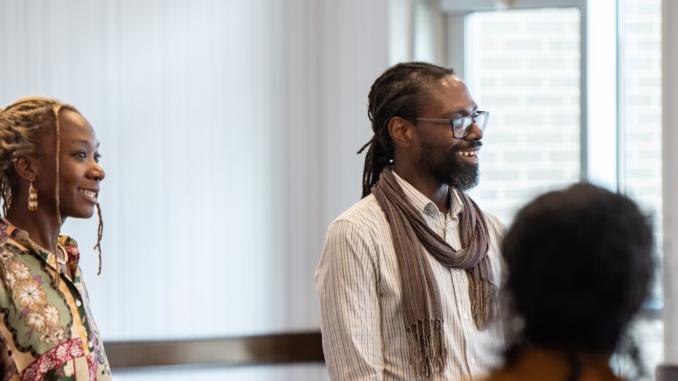
The Detroit native sheds light on the history of Black-owned businesses in his neighborhood, as well as how he’s working to restore his hometown through coffee and community.
BY MELINA DEVONEY
FOR BARISTA MAGAZINE
Photos courtesy of Martell Mason
Yesterday, we released Part One of our conversation with Martell Mason: founder of Sepia Coffee Project and a leader in the revitalization of Highland Park, an enclave of Detroit, Mich., where he grew up. Today, we continue our One On One with Martell to talk about the inspiration behind the name “Sepia Coffee Project,” the history of Black-owned businesses in Detroit, and the exciting things in store.

Melina Devoney: What is the meaning behind the name “Sepia Coffee Project”?
Martell Mason: The word “sepia” comes from the Latin name of the cuttlefish, which secretes a reddish-brown pigment that artists as early as the 17th century used in their art. With the invention of photography in the 19th century, photographers used sepia ink to produce warm, deep tones. Browns, reds, and creams can be seen in photographs produced during this period. Those hues inspired our brand’s concept. Established in 2021 when the U.S. and the world were experiencing so much on social, economic, and political fronts, it was important for me to build a safe and inclusive brand that represents our diverse community. As the brand’s identity developed, our name and logo took on even greater meaning. For example, if we look at our logo, the “sepian” rainbow, it represents:
- People: The sepian color schematic (sepia, browns, tans, yellows, and orange) is a depiction of an inclusive, representative platform created for all. Our motto has always been: by the people, for the people.
- Coffee: Our logo shows how our culturally diverse communities around the world take their coffee. Here in the U.S., black coffee is king. Throughout East Africa and Arabia, spices are added, while in Vietnam, condensed milk can sometimes be a non-negotiable addition. Regardless of how you take your coffee, at Sepia, we all belong.
- Origin: Our logo represents the elements. If you look closely, you will see the sun (sepia/rust color), rays of light (yellow, orange), and the terroir at origin (browns) mimicking rows of coffee trees. Without the four elements (earth, wind, water, and fire), none of what we do and love would be possible.
We are all sepians—folks on a mission to ensure our communities have what they need to grow and sustain themselves. Our platform creates a safe space for our underserved and undervalued communities. Through coffee, we are able—if only for a moment—to give some (of the people) within our community an opportunity to pause in the day, reset, and be present. Coffee, like food, has this amazing power, and I am grateful to be a coffee steward making this possible.

Sepia’s coffee collections also pay homage to Detroit’s Black neighborhoods. Can you tell me more about that?
The Great Migration of Black Americans from the South saw Detroit’s Black population skyrocket from 5,700 in 1910 to 120,000 by 1930, with many migrating to work in the automotive industry. Estimates show that as many as 350 Black-owned businesses were formed within Black Bottom. The district had doctors, dentists, lawyers, restaurants, salons, and a host of entertainment venues and diners, which of course served coffee way into the midnight hours.
Our coffee collections are inspired by the street names and prominent residents who once called the enclaves of Black Bottom and Paradise Valley home.
What challenges came with establishing Sepia Coffee in an underserved community?
The greatest hurdle we have faced over the last three years is securing funding to scale up business operations. Although Detroit has seen massive development, there are still enclaves within the city which are greatly underserved, hindering their ability to benefit from the city’s success and future growth prospects. Like an artist putting brush to canvas, I see a vibrant future in the enclave of Highland Park.
In 2024, we acquired a 3,200-square-foot property in Highland Park, and now need our coffee community near and far to support our efforts to get this building rehabbed in 2026. The property was likely a retail shop that was once connected to a residential home that was demolished decades prior. In Detroit, mixed-use buildings were designed to allow families to have their commercial businesses on the ground level with living quarters on the second and third floors. Our property in Highland Park was likely a carriage house that was reconfigured into a commercial outpost in the 1940s/’50s to take advantage of the population growth within the city. More jobs equaled more people, which meant more disposable income to purchase retail and home goods.

Growing up, I remember this building being a small appliance repair shop. Whether it was a broken washing machine or fan, you could take your appliances for repair and/or resell. Hamilton Avenue
was known for repair spots, furniture stores, and small antique shops. We have actually found a few old relics from our building that we hope to preserve, telling the story of decades past.
The second challenge we have faced is getting underserved and undervalued communities to see that they have value. For decades, urban communities, due to systemic inequalities, have been conditioned to believe that nothing is possible. The world reading this would probably think, “How hard is it to open a roastery and café?” Well, when political and social systems make it difficult for minorities to succeed, this becomes a generational crutch, with many just accepting the status quo.
It has definitely taken countless coffee pop-ups and coffee-and-conversation events around town to get residents to see that development from within the community is possible. With coffee, we are inspiring those who had given up hope. We are also reassuring our elders in the community that the backbreaking work they did in the past was not done in vain. Our work has given a lot of people a sense of peace knowing that the tide has shifted and businesses like Sepia Coffee are taking the necessary steps—and risks—to ensure our communities are restored with integrity.
Where have you looked for guidance in running Sepia Coffee?
I am grateful to have local, national, and international support. Over the years, several industry leaders have contributed to my growth and success. One person in particular who continues to guide me is the great Phyllis Johnson, owner of BD Imports and founder of the Coffee Coalition for Racial Equity (CCRE). Phyllis inspired me some 10 years ago to dive into the green coffee trading business. I remember emailing her years ago, not expecting a follow-up. But like the Phyllis we have all come to know and love, she responded! Her message was thoughtful, with each word of support full of great intention. For that, I am so grateful.
I’m excited to announce that I was accepted into CCRE’s inaugural Brewing for Equity Fellowship! Since its founding in 2020, CCRE has been committed to building racial equity and expanding opportunities in the coffee industry. The launch of the fellowship reflects a major milestone in that journey, connecting the organization’s first five years of advocacy to the development of future leaders. It is such an honor to be part of this inaugural group, and (I) look forward to building lasting relationships throughout this process.

Congratulations, that’s so exciting! What has been your biggest joy in the Sepia Coffee journey so far?
Two summers ago, I was at a coffee pop-up with a group of (fraternities and sororities from) historically Black colleges and universities. Two elders, probably in their 70s, came to our booth for a cup of coffee. We only source the highest-quality coffee, so I suggested that they both try it black before adding any sugar or cream, something our older generations are just programmed to do. It was an Ethiopian natural from Guji—super fruity, deep, and (with) rich berry and chocolate notes. They both agreed to try it black.
About 10 minutes later, I noticed that both ladies had finished their cups, sans sugar or cream. One of them picked up the empty cup and nudged her friend and said, “Smell it, smell the cup!” I believe what she was sensing and experiencing was the sweet aromatics of a well-processed Guji still bouncing in the
cup, something I’m sure she had never experienced with more mainstream commercial coffee. It’s moments like this that make me smile with pride. It confirms that we are doing exactly what we are supposed to be doing: giving our communities quality and service while eliminating filler.
The greatest job has been our ability, despite the challenges mentioned, to provide our community with a safe and inclusive space they can call their own. As the supplier, we have made it a focus to ensure prices are affordable to everyone in our community, regardless of income level. We are proud to be “Home of the $2 Drip,” making it possible for all of our neighbors to come in and enjoy a cup of our Hastings Blend.
ABOUT THE AUTHOR
Melina Devoney (she/her) is a barista and freelance writer in Los Angeles zeroed in on coffee and agriculture. She aims to amplify the voices of farmers and a diversity of perspectives within the coffee industry, and she’s happiest when running on wooded trails and dancing at concerts.
This article originally appeared in the December 2025 + January 2026 issue of Barista Magazine. Read more of the issue online here for free.

Subscribe and More!
As always, you can read Barista Magazine in paper by subscribing or ordering an issue.
Support Barista Magazine with a Membership.
Signup for our weekly newsletter.
Read the February + March 2026 Issue for free with our digital edition.
For free access to more than five years’ worth of issues, visit our digital edition archives here.