
As burnout remains a pressing issue amongst café staff, coffee leaders are being called to address the problem at the root.
BY BRIANNA STEFANO
BARISTA MAGAZINE ONLINE
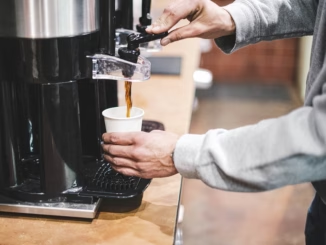
Featured photo by Jeremy Bishop
What to know:
- In a survey regarding emotional safety in the coffee industry, nearly 70% of respondents reported experiencing burnout while working in coffee
- Café leadership can help employees feel safer and mitigate stress by developing their communication skills, maintaining flexibility with scheduling, managing their workload expectations, and advocating for good work-life balance
Burnout—and how it’s impacting café staff—has become one of the most pressing conversations in specialty coffee. Yet, despite how frequently we discuss it, we often treat it as an individual problem rather than an organizational one. In some workplaces, the warning signs are even ignored altogether.
As a coffee professional, sociology professor, and mental health researcher, I have long been interested in the relationship between people and the systems they work within. Following my workshop “Mental Health as a Management Priority” at Northeast Coffee Fest 2026, I launched the Coffee Industry Emotional Safety Survey to better understand how coffee professionals experience workplace culture, support, and burnout.
The results were striking, though they unfortunately aligned with my expectations. 68% of respondents reported experiencing burnout while working in coffee, while another 12% reported actively experiencing burnout at the time they completed the survey. At the same time, 68% reported feeling pressure to appear positive, upbeat, or emotionally available while struggling personally.

For anyone who has worked in hospitality, these findings may feel familiar. Coffee professionals are often expected to manage customer emotions through hospitality while suppressing their own. Over time, that emotional labor can take a significant toll.
While emotional labor is often viewed as simply part of the job, leaders have substantial influence over how much strain employees carry. Communication practices, staffing levels, workload expectations, scheduling, and workplace culture all shape whether employees feel supported or overwhelmed. Burnout may be experienced by individuals, but it is really impacted by the systems surrounding them.

Changing systems at the core
What surprised me most was what respondents identified as potential solutions. When asked what would improve emotional well-being at work, 68% selected regular staff check-ins, 60% selected better communication, and 56% selected improved workload balance. Employees were not asking exclusively for wellness initiatives or mental health resources. They were asking for better systems.
Nicholas Cassotta, Manager of Rebel Dog Coffee in Plainville, Connecticut, sees systems as a critical part of workplace well-being. “They make the day-to-day more predictable despite any unexpected chaos that could be thrown at you during shifts,” Nicholas shared with Barista Magazine. “Having systems and expectations in place works as a fail-safe to lessen stressful moments, resulting in less strain and fatigue on your staff.”

The lingering effects of stress at work
The survey also revealed that only 41.7% of respondents reported having opportunities to decompress after difficult shifts. Nearly one-third reported that no such support existed in their workplace. That finding highlights an important reality: burnout is not always caused by the work itself. Often, it is influenced by the systems, or lack thereof, surrounding the work.
The survey findings align with what many industry leaders have observed firsthand. Wendelien van Bunnik, founder of the Happy Coffee Network, notes: “Baristas can burn out because they are constantly absorbing and managing the emotions of customers and coworkers while simultaneously handling the demands of fast-paced hospitality work. This is especially true for managers caught between owners and baristas, who often carry the emotional weight of both sides, and when that labor goes unrecognized or unsupported, burnout can happen quickly.”
Her perspective reinforces a key theme that emerged throughout the survey: Burnout is rarely the result of a single difficult shift or stressful interaction. More often, it develops when emotional demands accumulate without adequate support, communication, or opportunities for recovery.

How to move forward
Managers are not therapists, nor should they be expected to be. However, they do influence communication practices, scheduling, workload expectations, feedback systems, and workplace culture. Those factors can significantly impact whether employees feel psychologically safe and supported at work.
Managers cannot eliminate every stressful shift, difficult customer, or challenging day. What they can do is build environments where employees feel heard, valued, and equipped to succeed. If burnout has become a defining challenge in specialty coffee, addressing it requires more than individual resilience. It requires leadership, communication, and systems designed to support the people who keep our industry running.
Author’s Note: This article’s findings were based off the “Coffee Industry Emotional Safety Survey,” launched prior to the presentations on emotional intelligence and mental health leadership at Northeast Coffee Fest 2026. If you would like to contribute, please fill out the survey through this link: Coffee Industry Emotional Safety Survey
ABOUT THE AUTHOR
Brianna Stefano is a specialty coffee consultant, educator and adjunct professor at the University of Bridgeport with more than 15 years of experience in coffee. Drawing from backgrounds in sociology, organizational behavior, and coffee operations, her work focuses on leadership, workplace culture, professional development, and barista education. She is the founder of Brewing with Brianna and serves as Vice President of the Connecticut Coffee Collaborative.

Subscribe and More!
As always, you can enjoy your own copy of Barista Magazine by subscribing or ordering an issue. Long live physical media!
Support Barista Magazine and show your love with a Membership.
Signup for our weekly newsletter.
Join us at Camp Coffee Shop Aug. 10-13 in Napa, California.
Read the June + July 2026 Issue for free with our digital edition.