New research reveals how coffee consumer habits differ between the regions.
BY BHAVI PATEL
BARISTA MAGAZINE ONLINE
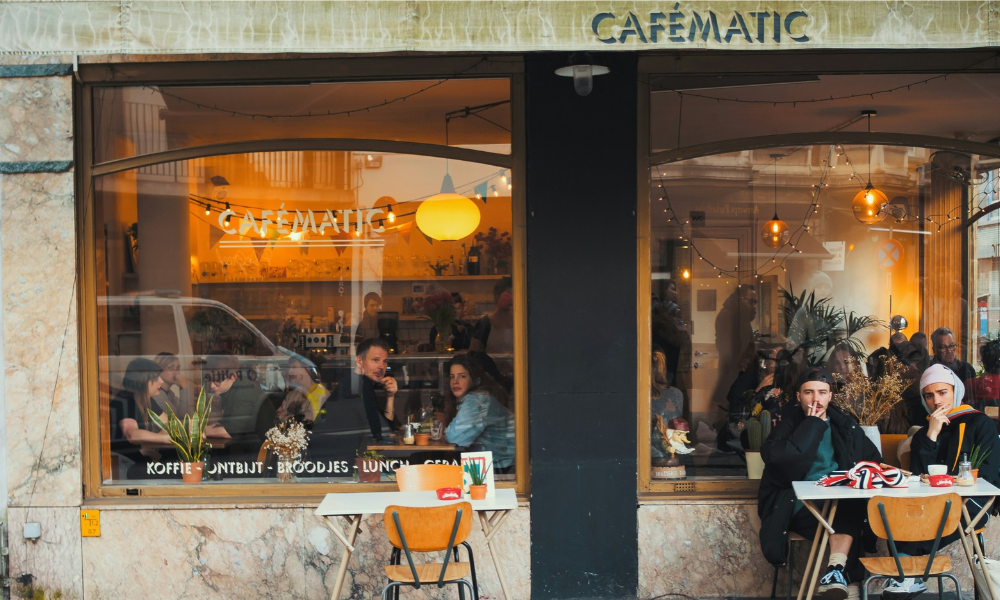
Featured photo by Wyron A.
What to know:
- According to a research paper comparing coffee markets in the U.S., UK, and continental Europe, the U.S. coffee market leads in size and scale
- Starbucks and Dunkin’ dominate the American market, while European coffee chains tend to have fewer locations; the UK stands out as Europe’s largest chain-coffee market.
- Coffee spending and consumer habits vary by region. Although coffee prices are similar across markets, Americans spend significantly more at coffee shops than Europeans. Broader menus, larger drink sizes, customization, loyalty programs, and drive-thrus help drive higher spending in the U.S.
- Business strategies differ across markets: American coffee chains attract more institutional investment and are more likely to use automated equipment, while European brands often focus on growing within their home markets. Across both regions, businesses that fail to differentiate themselves are facing increasing competition
Coffee is a global habit, but the coffee shop is a local business. A new research paper from WhiteSpace Partners, built on May 2026 unit counts across 24 European markets and the 20 largest U.S. brands, shows how differently the category has matured on each side of the Atlantic. The UK, counted within Europe yet scaled like a market apart, complicates the picture further. For operators, suppliers and investors weighing their next move, the contrasts matter as much as the common ground. Here is how the numbers stack up, and what they signal.

Big chains, bigger gaps: Who has the scale?
The U.S. plays in another league. Starbucks (16,822 units) and Dunkin’ (10,069) anchor a market where heritage brands founded before 1980 hold 27,533 units. Europe’s leaders, Starbucks (3,488) and Costa Coffee (2,967), look modest by comparison, and more than half of the European Top 50 run fewer than 100 units. The UK is the standout inside Europe, housing 36% of Top 50 units, with Costa (2,642), Starbucks (1,367) and Caffè Nero (634) leading. Density tells the same story: 73 units per million people in the UK against just 9 in France, while Greece tops the continent at 158.
Same price, different tab: Where does the money go?
Pricing no longer separates the regions; spending does. A “tall” latte at Starbucks costs $5.70 in New York, Munich, and Stockholm, $5.60 in Paris, $5.20 in London, and $6.00 in Los Angeles. Per capita spending at specialty-coffee shops hit $154 in the U.S. in 2025, against $25 in Western Europe and $8 in Eastern Europe. The paper credits broader menus, bigger sizes, customization, mature loyalty programs, and drive-thrus. Starbucks and Scooter’s Coffee carry more than 160 permanent beverage SKUs, while leading European operators offer roughly 25 to 50-plus.
Money & machines: Who’s betting on what?
Capital leans American. Eight of the U.S. Top 20 carry institutional backing, and three are public, whereas Starbucks stands alone as Europe’s public name. Automation is similarly uneven, with 5 of the U.S. Top 20 using automatic machines against 3 of Europe’s Top 50. Growth habits differ as well: Half of Europe’s Top 50 operate in a single market, so depth at home drives scale. One pressure is shared, as McWin’s Vaibhav Juneja notes: The “undifferentiated middle” is increasingly squeezed on both continents.
No region is simply ahead or behind. The U.S. wins on scale, spend, and menu breadth, continental Europe on a rich mix of local champions, and the UK on a rare blend of chain density and real competition. Operators entering any of them should price for parity but plan for different baskets, from broader menus to stronger loyalty tools. Suppliers face a parallel split between manual craft and automated convenience. Success will favor brands whose formats fit local habits rather than imported assumptions. For coffee professionals, the paper offers a useful map of where growth is real and where it is only assumed.
ABOUT THE AUTHOR
Bhavi Patel is a food writer focusing on coffee and tea, and a brand-building specialist with a background in dairy technology and an interest in culinary history and sensory perception of food.

Subscribe and More!
As always, you can enjoy your own copy of Barista Magazine by subscribing or ordering an issue. Long live physical media!
You can read the digital edition of Barista Magazine for free here.
Support Barista Magazine and show your love with a Membership.
Signup for our weekly newsletter.
Join us at Camp Coffee Shop in Napa, California.