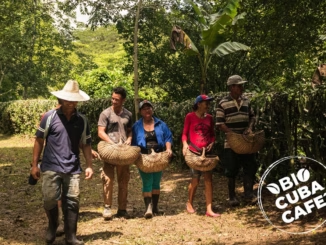

Growing up in rural Kenya, Margaret Nyamumbo saw firsthand how gender inequity impacts women in producing countries: an issue she’s set out to combat through her work in coffee.
BY DANIEL MURAGA
BARISTA MAGAZINE ONLINE
Photos courtesy of Margaret Nyamumbo
Despite proactive legislation efforts and enactments in some countries in Africa, societies on the continent are still predominantly patriarchal. Women are marginalized and discriminated against at both the family and societal levels. For example, in Kenya, women do not normally and directly own land or movable property. Their rights are tied to their relationships with their fathers, husbands, or brothers.
FIDA-Kenya reports that, though the ratio of men to women in Kenya is 1:1, only 1% of land titles are held by women; however, 89% of subsistence and 70% of cash crop-farming labor is provided by women. In addition, cultural, social, and legal factors combine to make it impractical for women to own land. This means that without owning the means of production, women are relegated to mere labor providers with limited economic benefits gained from what they labor upon.
One young woman entrepreneur, Margaret Nyamumbo, witnessed these inequalities in the coffee sector and vowed to take action. Margaret was born and raised on her grandfather’s coffee farm in rural Kenya, where she saw firsthand how women in her community provided most of the labor but owned very little land.
Margaret would later move to the United States, where she obtained an MBA from Harvard and started a career in finance on Wall Street—and still, the thought of changing the societal ills she saw on her grandfather’s farm never left her mind. In 2017, she founded Kahawa 1893 to sell East African coffee to the world in a way that would put women farmers at the forefront.

From Wall Street to the coffee world
“Working very late in the offices (of) New York, I relied on coffee to stay awake,” Margaret told Barista Magazine. “The office coffee was not very good, and one night, I wondered why we couldn’t have delicious Kenyan coffee in the office. I also wondered what happened to the coffee that we exported from our farm in Kenya. I started visiting coffee shops in New York to look for Kenyan coffee, but it was hard to find.”
This experience on Wall Street sparked curiosity in Margaret, leading her to investigate the coffee supply chain. According to Margaret, the more she learned, the more she noticed that there was no African-owned coffee brands within the U.S. market—even though a lot of coffee was being produced in East Africa, and Kenya grows some of the most sought-after coffee in the world. In launching Kahawa 1893, she hoped to fill this gap.

“The name was intentional: Kahawa means ‘coffee’ in Swahili, and 1893 was the year coffee was first commercially grown in Kenya,” says Margaret. “The name ‘Kahawa 1893’ celebrates Africa’s special role in shaping coffee culture.”
Kahawa 1893 currently partners with coffee cooperatives in Kenya, Rwanda, and Congo, from which it sources beans for its single origin coffees and blends. The initiative also supports other philanthropic activities in the region, including sugarcane farming, corn mill operations, scholarships for girls, livestock buying, and disaster relief services, to empower women and local communities.
Empowering women producers
According to Margaret, one of the ways Kahawa 1893 empowers women is through a women’s fund program, which brings back some of the wealth from coffee-consuming countries back to the communities that produce coffee. This works by providing a tipping platform where consumers around the world can send tips to women farmers through the farmers’ coffee cooperatives. Using these funds, women are economically empowered and can supplement what they get from coffee farming.
“The tips go into a women’s fund that’s run by the women in the coffee cooperatives that we partner with. The women have invested in various projects in their community,” Margaret says. “In Kenya, in Kisii town, they have invested in a posho (corn) mill to process maize meal (or ugali, a local daily meal), so they do not have to walk long distances to the closest one. They also set up a scholarship fund for young girls in the community so they do not drop out of school due to a lack of school fees.”

In Rwanda, the cooperative that Kahawa works with gives goats to women farmers as a gift. Goats are an asset and income-generating property that produce milk and meat. In Congo, money from the coffee fund has helped farmers deal with disaster relief efforts, especially in rebuilding homes and businesses after recent floods.
Another way Kahawa uplifts women producers is by marketing women-produced coffee and creating demand from customers, therefore increasing the value of women’s work in the supply chain. With this, more and more exporters now have a dedicated supply chain for women-produced coffee.

According to Margaret, her efforts in educating consumers about the gender gap in coffee have successfully created engagement in customers who want to support women directly. She sees it as all linked: Increasing demand encourages women’s participation in the coffee chain, and that visibility demands a premium.
Mapping the future of coffee
Kahawa 1893 exports green coffee from East Africa to the U.S., where it’s freshly roasted and packaged for sale in grocery stores and to their customers online. They also serve coffee to major offices in New York. According to Margaret, Fortune 500 companies like Goldman Sachs, The New York Times, BlackRock, and Airbnb have enjoyed Kahawa in their offices.
The company has also created a special coffee that they call “African Spice” or “Dirty Chai,” as referred to in the U.S. when chai is mixed with coffee. This coffee was inspired by how coffee was historically enjoyed on the Kenyan coast, where spice traders experimented with adding ingredients like cardamom, cinnamon, and clove to coffee.
While Kahawa currently sources from Kenya and has relationships with cooperatives in Rwanda and Congo, Margaret shares that her team is currently working to develop more partnerships in Ethiopia, Uganda, and Tanzania. “Our mission is to showcase the beauty and diversity of East African coffee and create more economic opportunities for producers,” she says.
ABOUT THE AUTHOR
Daniel Muraga (he/him) is a communications expert, researcher, writer, and editor based in Kenya with over 10 years of experience in the industry. His mission is to highlight Africa’s contributions to the realms of science, technology, innovation, culture, food, and related fields. He has done extensive research and written widely in the coffee niche for Sprudge Media, as well as in related areas for Life & Thyme and CQ Researcher, among others. When not writing, he is always outdoors communing with nature. You can find him on Facebook, X, and LinkedIn.

Subscribe and More!
As always, you can get a hard copy of Barista Magazine by subscribing or ordering an issue.
Support Barista Magazine and show your love with a Membership.
Signup for our weekly newsletter.
Join us at Camp Coffee Shop Aug. 10-13 in Napa, California.
Read the April + May 2026 21st Anniversary Issue for free with our digital edition.
For free access to more than six years’ worth of issues, visit our digital edition archives here.