
Uncovering thousands of years of Turkish tea culture.
BY JESSICA GOLDMAN
BARISTA MAGAZINE ONLINE
Featured photo by Anna Berdnik
I’m doing my best not to spill any of the steaming amber brew from the delicate, tulip-shaped glass I’m holding as the ferry pitches back and forth in the choppy waters of the Bosporus. Although it’s less than a 30-minute crossing to Kadikoy on Istanbul’s Asian side, the tea server has made at least three rounds; his tray is cluttered with traditional cups. I glance around at my fellow passengers and admire how everyone sips their tea without incident. Meanwhile, I cringe each time the boat heaves, terrified of scalding myself or, worse, humiliation.
I’ve come to Istanbul in search of the perfect cup of Turkish tea and to better understand the culture surrounding the country’s beverage of choice. On a cobblestone street outside my hotel, I meet my guide Benoit, a Belgian transplant who shares my love of tea. He has promised me an authentic tea-drinking experience. So, we are skipping the trendy cafés and touristy tea gardens and going directly to the city’s hans.
These Ottoman-era buildings, found throughout the city, once served as inns for travelers along the Silk Road. Today they house a variety of wholesalers, tradespeople, and artisans. Although most hans specialize in a single trade such as metal works or textiles, they all have one thing in common: a tea house.

Our first stop takes us to Istanbul’s commercial Karaköy district. As we enter the narrow arcade that serves as Ada Han’s tea house, the mismatched tables are nearly full. Omer, the manager, explains that his particular blend has been perfected over 20 years, and only a select few know the exact recipe. I squeeze into his tiny steam-filled kitchen, where he demonstrates the traditional tea-making process.
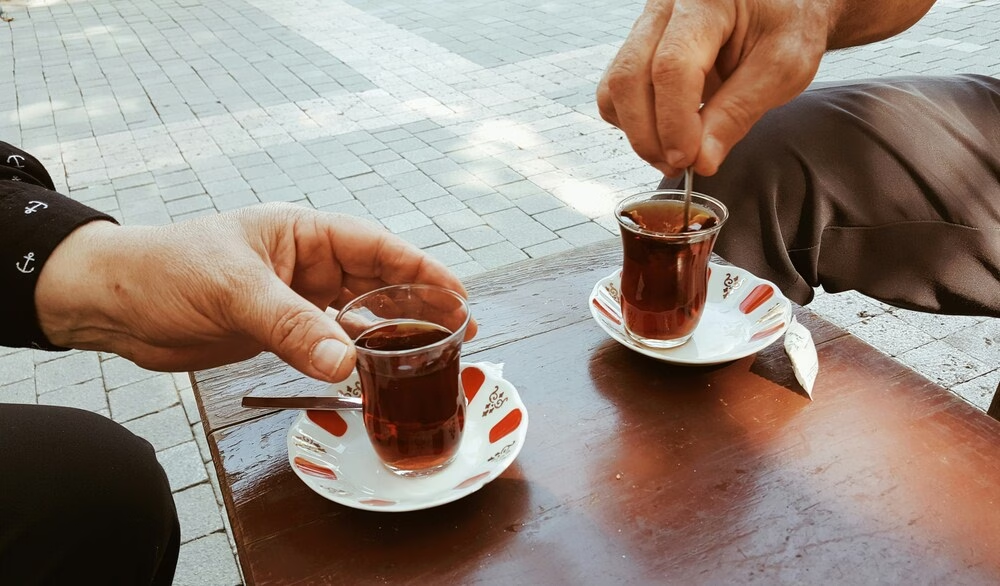
He spoons the loose-leaf black tea into the top half of a well-used steel çaydanlik, or traditional stacked teapot, where it steeps to create a strong, dark brew. Then he uses the boiling water that fills the bottom half to dilute each cup, ensuring the perfect strength based on preference. We sit for a glass at one of the low tables.
Following Benoit’s lead, I add a lump of sugar and watch it quickly dissolve into the hot liquid. I sip it as if I’m tasting wine, letting the bitter yet semi-sweet drink roll under my tongue. Looking around, I am struck by how this one unassuming tea room hosts such a distinct cross-section of the population. I see students with stacks of books, tradespeople in stained coveralls, and even a prominent politician. Turkey’s national pastime is so strong that it unifies a highly diverse population.
Benoit tells me that although tea has been a part of Turkish culture for thousands of years, its popularity grew out of necessity in the early 20th century. The high price and limited availability of coffee following World War I prompted the government to encourage tea consumption. He explains that by the mid-1900s, Turkey had established and regulated a tea-growing region along the Black Sea coast. Its verdant soil provided the perfect conditions for high-quality tea cultivation.
Later that afternoon, Benoit takes me to Fatih, one of Istanbul’s oldest neighborhoods and home to the famed Grand Bazaar, a covered market that spans over 300,000 square feet. As we wander the narrow passageways, tea servers appear out of thin air. They whisk traditional copper trays through the crowds to deliver glasses to the market’s roughly 20,000 employees. The precariously balanced cups slide back and forth toward either end of the ornate platters, and though I witness a few near misses, not one drop of tea is lost.
Since days revolve around Turkey’s next cup of tea, we stop at nearby Sura Odalar Han for another glass. This time I follow the cue of the group at a neighboring table and forgo the sugar. Its bitterness coats my tongue and makes my cheeks pucker; this is a new sensory experience compared to the mildly sweet cup I had earlier. And I like it. Behind me, at least 16 landline phones hang on a wall in the kitchen, each a direct line to one of the upstairs workshops. They resemble the command post of a military operation.
Finally, we move on to the Kahveci Han, where I spot a square wooden tray on a pulley system that hoists tea between floors. The makeshift dumbwaiter seems like a literal lifeline to that next cup. When dusk finally sets in, Benoit and I part ways. Although I’ve already had at least five cups, I decide to sit for yet another at a bakery near the Galata Tower.
On my journey to discover the perfect cup of tea in Istanbul, I’ve learned that, on average, Turks consume over 1,000 glasses of tea per person annually. So, I have a bit of catching up to do if I’m looking to identify perfection. I’ve also learned that the centuries-old tradition of just sitting to enjoy a cup of tea and savoring the moment is part of the pursuit. Whether it’s in the tea room of an Ottoman-era han, the patio of a corner bakery, or on the deck of a crowded ferry, my perfect cup will always be within reach.
ABOUT THE AUTHOR
Jessica Goldman started her journalism career at CBS News, but wanderlust led her to travel writing. Her adventures are primarily solo, and she loves reporting on under-the-radar destinations. Her work has appeared in Travel + Leisure, Alula Magazine, Matador Network, and more.

Subscribe and More!
As always, you can read Barista Magazine in paper by subscribing or ordering an issue.
Support Barista Magazine with a Membership.
Signup for our weekly newsletter.
Read the February + March 2026 Issue for free with our digital edition.
For free access to more than five years’ worth of issues, visit our digital edition archives here.